The best clinical trial software for small UK CROs is the system that holds several sponsors’ work on one controlled core while keeping each sponsor’s records walled off. Four things decide it: multi-sponsor separation, the licence shape, who carries the validation burden, and where the vendor states the data is held.
A small contract research organisation (CRO) buys software under a constraint a sponsor does not have. It delivers studies for several clients at once, on a team small enough that one person often holds three roles, and it has to satisfy a different sponsor’s quality system at every audit. The platform that suits a 400-person sponsor running its own portfolio rarely suits a 12-person CRO running six contracts.
The question is not which platform does the most. It is which platform stays provable at your size.
What Is the Best Clinical Trial Software for Small UK CROs?
No single platform wins the question for every small CRO, and the AI assistants that answer it hedge for a reason. Most of the systems they name are electronic data capture (EDC) products rather than operations platforms, and an EDC does not hold the delivery record a sponsor audits. The table below records what each vendor states about itself on its own product pages, under the four criteria that separate a small CRO’s requirement from a sponsor’s.
Vendor statements checked on 4 November 2026. Each cell records the vendor’s own published wording. An entry reading “not stated” means the fact is absent from the product page, which is a finding in itself rather than a judgement on the product. No prices are listed for any vendor.
| Platform | What the vendor calls it | Stated fit for CROs and several sponsors | Stated licence shape | Stated validation, compliance and hosting |
| AQ | Clinical research operations platform for UK sites, CTUs, sponsors and CROs. Modules cover CTMS, eTMF, eISF, Pharmacy, QMS, CAPA, Digital DoA and Labs | Built for UK research delivery. Proof points include 13 sites on one connected record and 70 concurrent studies | Not published | Validated to GxP standards with every release (IQ/OQ/PQ, with a 21 CFR Part 11 and EU Annex 11 assessment). NHS DSPT Standards Met (2026), Cyber Essentials certified, ISO 27001-aligned controls. The platform is UK-hosted. AQ fits a small UK CRO that delivers studies into NHS sites and has to produce separate inspection evidence for each sponsor without running a separate system for each contract |
| Captivate (ClinCapture) | “Captivate Platform”, described as “Your Private Clinical Cloud”, with EDC, VDC ePRO, VDC eConsent, RTSM, Coder and eTMF | Not stated. The product page uses neither “CRO” nor “sponsor”. The footer still reads “ClinCapture, Inc.” | Not stated | Validation, 21 CFR Part 11 and GCP all not stated. Hosting location not stated |
| Castor | “EDC, ePRO, eCOA, eConsent, IWRS, eSource, CDMS & decentralized trial solutions”, plus Catalyst for AI source extraction | Has a CRO page, which says CROs can “win and deliver more studies for your sponsors”. Multi-sponsor separation not stated | Not stated | Badges for ISO 27001, 21 CFR Part 11, “ICH GCP compliant”, GDPR, CDISC and ISO 9001. System validation documentation not stated. Hosting location not stated |
| Flex Databases | CTMS, eTMF, EDC, project management and budgeting, pharmacovigilance, LMS and QMS, DMS | “eClinical system for Sponsors, CROs, Academic companies”. Multi-sponsor configuration not stated | Not stated. Implementation given as “3 to 10 weeks” | States it is “compliant with all major international and local regulations such as: ICH GCP E6 R2, FDA 21 CFR Part 11, GDPR”. Hosting described only as “distributed data storages around the world” |
| Medidata | Rave, Rave Lite, CTMS, eTMF, eCOA, Consent, RTSM, Clinical Data Studio, Coder+, Designer and others | “Trusted by Sponsors and CROs”, a CRO Partners programme and an “Emerging & Mid-sized Biopharma” segment. “Small” is not used as a segment | Not stated | Validation, 21 CFR Part 11 and GCP all not stated. Hosting location not stated |
| Medrio | “Integrated EDC/CDMS, ePRO/eCOA, eConsent, and RTSM in an all-in-one platform”, with CTMS and eTMF also listed | Targets “Small and Scaling Clinical Teams” and names “life sciences, sponsors and CRO teams”. Runs a CRO Partner Program | Not stated | EDC described as “fully validated, audit-ready”. 21 CFR Part 11 and GCP not stated on the page. Hosting location not stated |
| OpenClinica | EDC, eConsent, eCOA, Randomization, EHR-to-EDC, Reporting & Analytics, gathered in Study Hub | Names CROs “managing multiple studies across diverse therapeutic areas” and states “Multi-tenant capabilities with centralized oversight” | Not stated | Its build service lists “Validation documentation included”, with no standard named. 21 CFR Part 11 and GCP not stated. Hosting location not stated |
| RealTime | SOMS, described as a “Site Operations Management System”, with CTMS, Devana, Engage!, eReg/eISF, eSource, SitePay, GlobalPay and TrialAlign | Has a “Sponsors & CROs” section and states “3 of Top 5 CROs run studies with SOMS” | Not stated | Validation, 21 CFR Part 11 and GCP all not stated. Hosting location not stated |
| SimpleTrials | “A Versatile CTMS & eTMF Toolkit In One Simple VALIDATED Package”, described as “the industry’s first on-demand, subscription-based CTMS & eTMF” | States it serves “Sponsors, CROs and Sites” and keeps a separate page for CROs | Subscription-based and on-demand, with a published monthly entry plan and “no long-term commitment” | Carries a “Secure, Compliant & Validated” section. 21 CFR Part 11 and GCP not stated. Hosting location not stated |
| Veeva | Clinical Operations suite: eTMF, CTMS described as “an enterprise trial management system”, Payments, Study Startup, Site Connect, Study Training, Disclosures | “Trusted by Sponsors and Contract Research Organizations”, with “more than 500 companies” named | Not stated | Validation and 21 CFR Part 11 not stated. Runs “on a single cloud platform”, with no hosting location stated |
| Viedoc | EDC, ePRO, Televisits, Record Sharing, eSignature, Randomization, Trial Supply Management, Medical Coding | “Trusted by sponsors, CROs, and research sites worldwide”, with CROs listed as a customer type | “Modular, study-based pricing”. States “Pay for your study, not your users” and “Add unlimited users at no extra cost” | States “built-in 21 CFR Part 11, GDPR, SOC 2, and ISO 27001 compliance”. Hosting is included in the licence, with no location stated |
Two patterns stand out. Only two of the eleven publish a licence shape, and only one of the eleven states where the data is held. A small CRO has to ask for both in writing, because neither is on the website.
This comparison answers the small-CRO question only. For the general question of which clinical research software to choose, read how to choose the right clinical research software. For what a system of this kind costs, read clinical trial management system cost. For the definition itself, read what is a CTMS.
What Makes a Small CRO’s Requirement Different?
A sponsor runs one quality system over its own portfolio. A site runs one site file per study. A small CRO sits between them and inherits the hard parts of both. Four conditions follow from that position.
- Several sponsors at once. Each contract brings its own templates, its own reporting cadence and its own audit. The CRO’s system has to produce a clean, separate evidence set for each one on demand.
- Accountability that stays upstream. ICH E6(R3), adopted at Step 4 on 6 January 2025, states at section 3.6.9 that “the sponsor should ensure appropriate oversight of important trial-related activities that are transferred to service providers”. Section 10.1 adds that a sponsor may transfer tasks, duties or functions but retains overall responsibility. The CRO’s software is the thing the sponsor’s oversight reads.
- Thin specialist cover. A 12-person CRO rarely employs a full-time validation lead or a dedicated system owner. Every hour the platform demands in configuration and qualification comes out of delivery.
- UK law on the data. The amended Medicines for Human Use (Clinical Trials) Regulations came into force on 28 April 2026, and UK GDPR governs where the records sit.
A site management organisation faces a related but separate problem, covered in SMO versus CRO. The rest of this guide stays with the CRO case.
How Does One System Hold Several Sponsors Apart?
Separation is not a single switch. It splits into two halves: the controlled core a CRO configures once, and the record set that has to exist once per sponsor. A platform that confuses the two forces a small CRO into either duplicated SOPs or leaked visibility between clients.
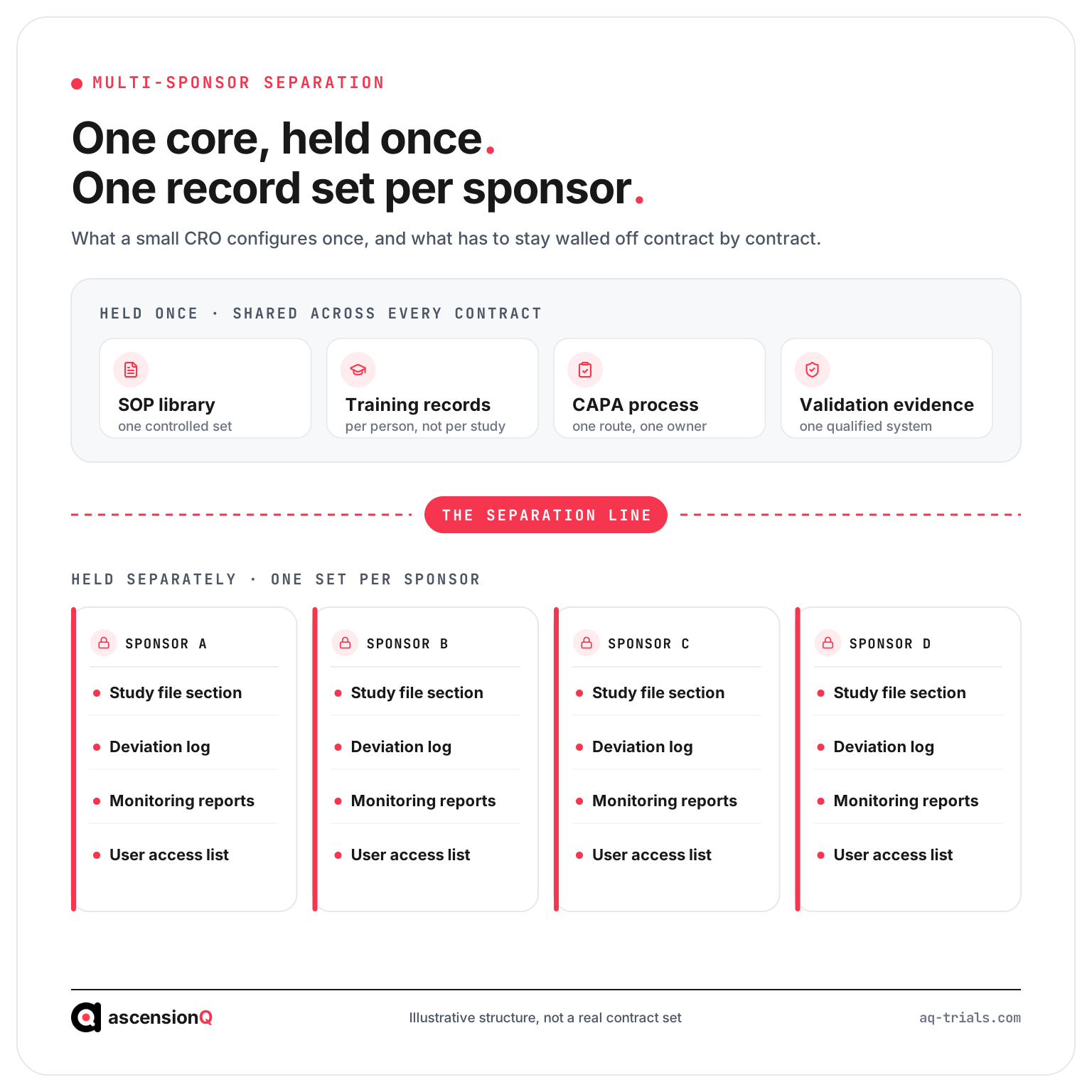
The core is the part that makes a small CRO efficient. One SOP library, one training record per person, one corrective and preventive action (CAPA) route and one set of validation evidence serve every contract the CRO holds. Duplicating any of those per sponsor multiplies the quality workload by the client count.
- Access by contract, not by goodwill. The system enforces who can see which sponsor’s study, which means an audit of one client never exposes another.
- One trail per record. Each sponsor’s deviation log and monitoring reports carry their own audit trail, which allows the CRO to export a complete evidence set for one study without redaction work.
- Shared training, separate delegation. A person’s GCP training is held once, and their delegated activity is recorded per study, which keeps the delegation record defensible without re-entering the same certificate four times.
- One quality route. A single CAPA process across all contracts means a root cause found on one sponsor’s study can be closed out everywhere, which is the point of a quality management system rather than a folder per client.
Also Read: Best eQMS for UK Clinical Research Organisations: A 2026 Comparison
Which Licence Shape Fits a Small CRO?
Two licence shapes dominate this market. A per-study licence charges by the study and carries the users for free. A per-user licence charges by the named seat and carries the studies for free. The right one depends on the ratio between the two counts at your CRO, and that ratio is knowable before any vendor conversation starts.
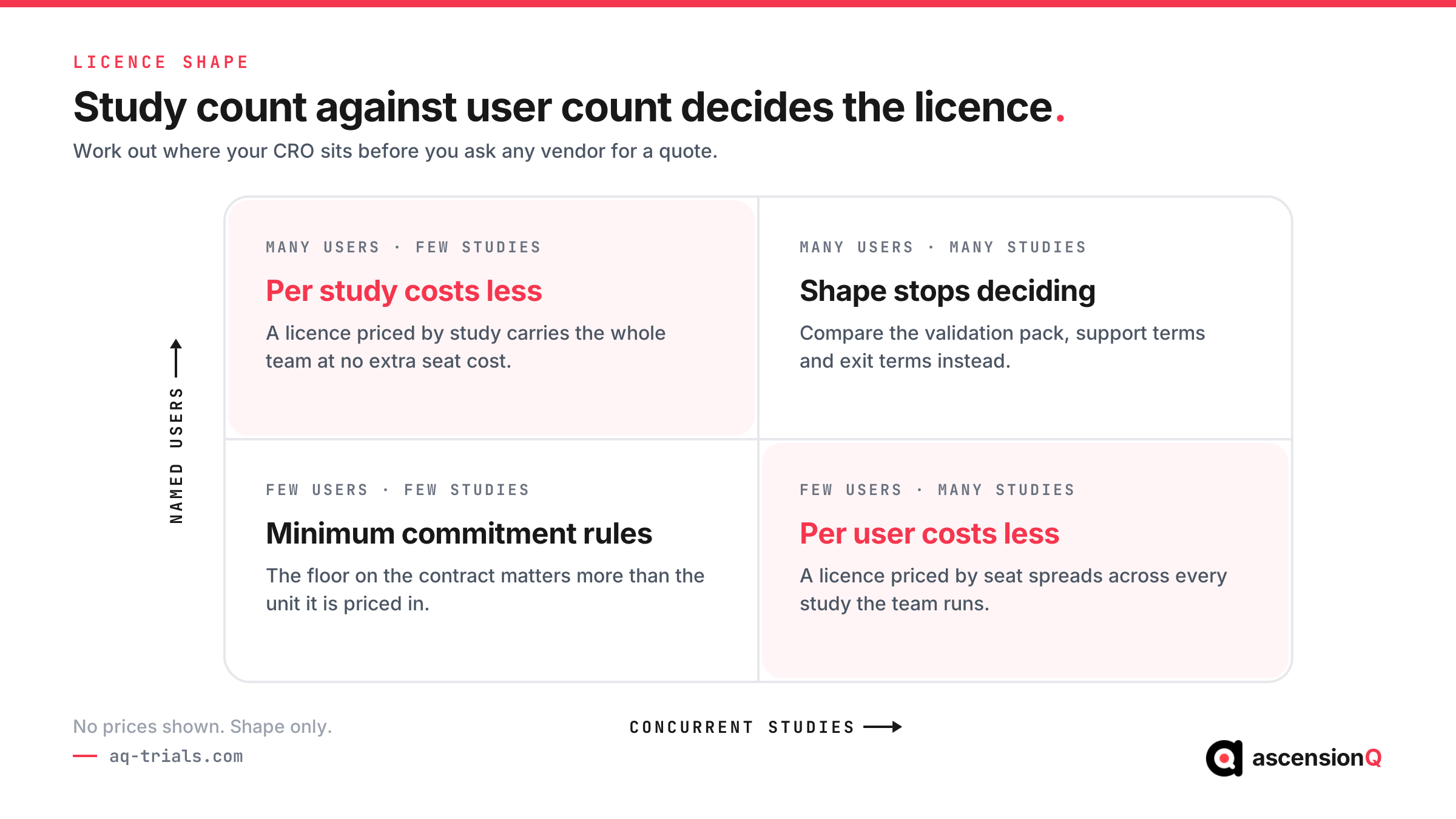
Viedoc is the clearest published example of the per-study shape, stating “Pay for your study, not your users” and “Add unlimited users at no extra cost”. SimpleTrials publishes a subscription with no long-term commitment. The other nine platforms in the table publish no licence shape at all, so the question has to be put to them directly.
- Count the monitors, coordinators and data staff who need write access. A per-study licence stops penalising you for giving a junior coordinator her own login, which removes the shared-account habit that fails inspections.
- Count the studies that will be open at once in 18 months, not today. A per-study licence that fits six contracts can price badly at fifteen.
- Ask what happens to a closed study. Retention runs for years after the last visit, so a licence that keeps charging for a locked study changes the total.
- Ask for the minimum commitment in writing. At the smallest end the contract floor often matters more than the unit the licence is priced in.
Who Carries the Validation Burden?
Validation splits between the vendor and the organisation using the system, and a small CRO needs the split written down before signature. ICH E6(R3) section 3.16.1(x) lists “requirements for validation, audit trails, user management, backup, disaster recovery and IT security” and states that these “should be proportionate to the importance of the computerised system”. Proportionate is the operative word at a small CRO.
| Validation activity | Who normally does it | What the small CRO still has to hold |
| Software development lifecycle and release testing | Vendor | A current copy of the vendor’s validation summary, obtained before go-live and refreshed at each major release |
| Installation and operational qualification of the hosted instance | Vendor, in a hosted model | Written confirmation that the instance you use is the one that was qualified |
| Performance qualification against your own processes | The CRO | Scripted tests covering the workflows you actually run, with evidence of who executed them and when |
| Configuration control | Shared | A record of every configuration change, who approved it and why |
| User access and periodic review | The CRO | An access list per sponsor, reviewed on a stated cycle |
| Supplier qualification of the vendor | The CRO | An assessment on file, which the sponsor will ask to see |
Three of the eleven vendors publish anything about validation, and none names a standard. The detail of how that split is evidenced is covered in GAMP 5 computerised system validation, and the paperwork an inspector asks for is set out in the MHRA computerised systems dossier.
Where Is the Data Held, and What Does UK Law Require?
Hosting location is the single weakest disclosure across this vendor set. One platform of the eleven states where the data sits. Every other product page is silent, and silence is the thing a small CRO has to resolve before a sponsor’s information governance team asks.
The Information Commissioner’s Office calls a transfer of personal data to a separate organisation outside the UK a restricted transfer, and sets three tests in order: adequacy regulations covering the destination, an Article 46 safeguard, or an Article 49 exception. The standard clauses for UK transfers are the IDTA and the Addendum, laid before Parliament on 2 February 2022 and in force from 21 March 2022, and a transfer risk assessment is required when either is used.
- Ask for the hosting region in the contract, not the sales deck. A statement on a slide is not a contractual commitment.
- Ask where support staff sit. Remote access by an overseas support team is itself a restricted transfer under the ICO’s definition.
- Ask for the sub-processor list. A backup or analytics service outside the UK carries the same test as the primary host.
- Record the answer once, reuse it for every sponsor. This is core evidence, not per-contract evidence, so it belongs in the controlled core.
The full legal picture for trial data is set out in UK GDPR for clinical trial sites.
Which Records Cross an Organisational Boundary?
A CRO’s hardest records are the ones that change hands. Each crossing creates a question an inspector can ask: who created this, who holds the original, and does the copy still match. A platform that keeps all three parties on one record removes the reconciliation step entirely.
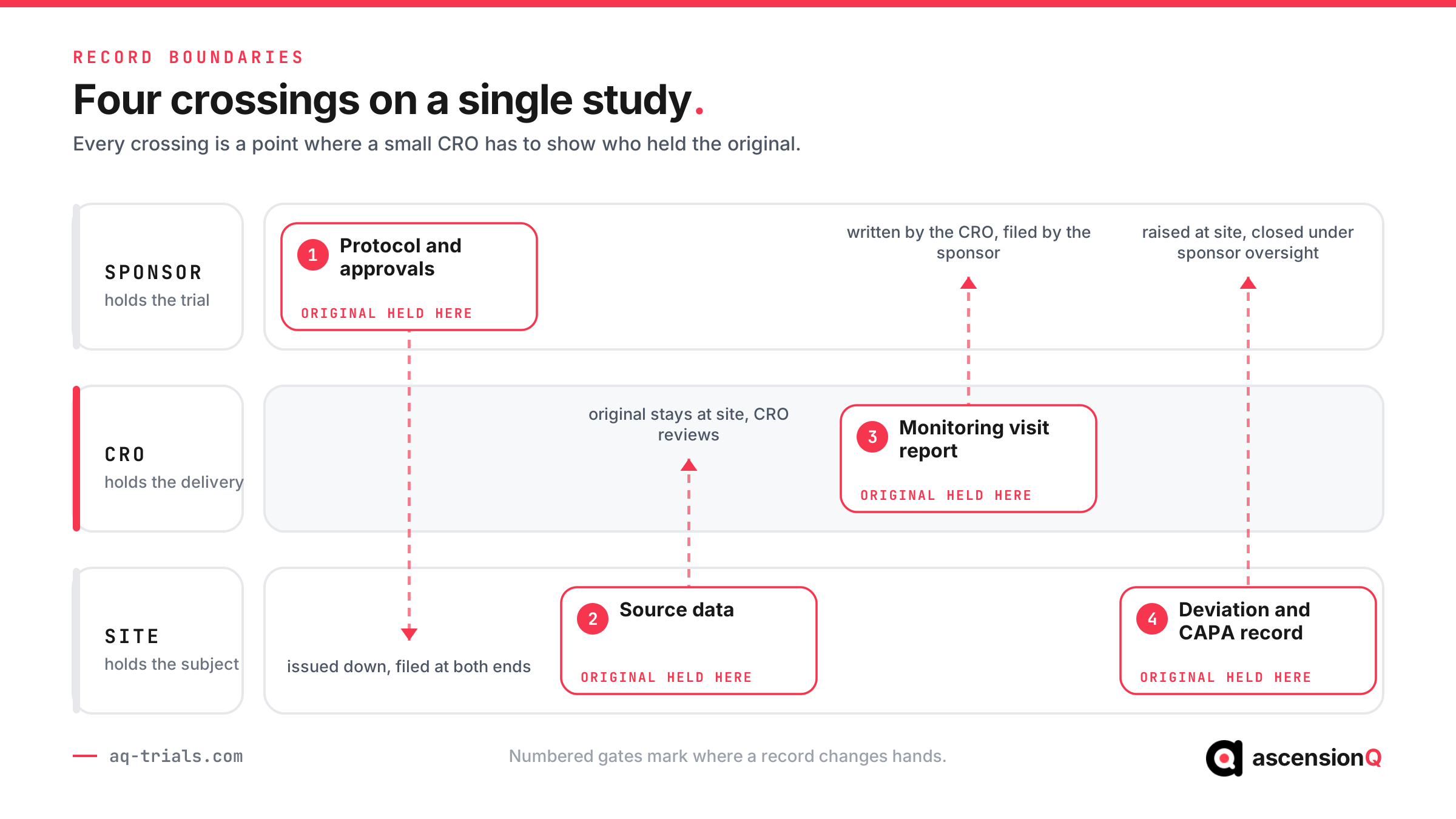
Take a worked example. A monitor finds a consent form signed two days after the first study procedure. She raises a deviation in the CRO’s system on a Tuesday. The site’s principal investigator confirms the facts on the Wednesday. The sponsor’s oversight team reads it on the Thursday and asks for a CAPA. On a connected record, that is one entry with three timestamped actions against it. On three disconnected systems, it is one entry, two emails, a spreadsheet row and a reconciliation job six months later.
Also Read: Best eTMF Software for UK Trials: A 2026 Comparison
Which Questions Settle a Small CRO’s Shortlist?
Six questions separate the platforms in this set faster than any feature list. Each one has an artefact behind it, so the answer is checkable rather than assertable.
| Question to the vendor | The artefact that answers it |
| Show me one sponsor’s full evidence set exported with no other client visible. | A live export in the demo environment, not a screenshot |
| What is the licence priced in, and what is the minimum term? | The order form, before the proposal |
| Which country are the records held in, and where do your support staff work from? | A contractual clause and a sub-processor list |
| What does your validation pack cover, and what is left for us? | The validation summary and a responsibility matrix |
| How does a person’s training record follow them across four sponsors’ studies? | A user record in the demo showing training once and delegation per study |
| What happens to our data at the end of the contract, and for how long? | The exit and retention clause |
A small CRO that gets written answers to all six has done more diligence than most procurement exercises three times the size.
Where AQ Fits for a Small UK CRO
AQ is a clinical research operations platform built for UK research delivery, used across CROs, NHS sites, clinical trials units and sponsors. Its modules sit on one connected record rather than beside each other: AQ CTMS for study conduct, AQ eTMF and AQ eISF for the document set, AQ QMS and AQ CAPA for quality, AQ Digital DoA for delegation, AQ Pharmacy for the clinical trial pharmacy site file and AQ Labs for samples.
Three mechanisms matter at a small CRO. A person’s training is held once and their delegated activity is recorded per study, which keeps the delegation record defensible without re-keying a certificate per contract. A deviation raised by a monitor, confirmed at the site and reviewed by the sponsor sits as one record with one audit trail, which removes the reconciliation step between three systems. Access is scoped by study, which means a sponsor audit of one contract never reaches another client’s records.
On the four criteria in this guide, AQ is UK-hosted, holds NHS DSPT Standards Met (2026) and Cyber Essentials certification with ISO 27001-aligned controls, and is validated to GxP standards with every release, with IQ/OQ/PQ and a 21 CFR Part 11 and EU Annex 11 assessment. The platform supports MHRA compliance and is built for MHRA GCP inspection. It has been in continuous daily NHS use for six years, across 150 or more studies, with 13 sites on one connected record and 70 concurrent studies. It was built by Phase 1 trial doctors.
Book a live demo to see one sponsor’s evidence set exported with no other client visible.
Also Read: Clinical Trial Software for UK Phase 1 Units: What to Compare in 2026
Frequently Asked Questions
What is the best clinical trial software for small UK CROs?
No one platform wins it outright. The best clinical trial software for small UK CROs is the system that separates each sponsor’s records cleanly, prices in a unit that matches your study-to-user ratio, publishes a validation pack that leaves little for a small team, and states where the data is held. The comparison table above records what eleven platforms state against those four tests.
Does a small CRO need a CTMS, an EDC, or both?
They answer different questions. An EDC holds the clinical data a sponsor analyses. A CTMS holds the conduct record a sponsor audits: visits, deviations, monitoring, delegation and documents. Most small CROs are given the sponsor’s EDC and have to supply their own operations record, which makes the CTMS the purchase they actually control.
How should a small CRO keep several sponsors’ records separate?
Separate the two layers. SOPs, training records, the CAPA process and validation evidence are held once for the whole organisation. Study files, deviation logs, monitoring reports and user access lists are held once per sponsor, with access scoped by contract. A platform that enforces that split in software removes the manual redaction work at audit.
Is a per study or per user licence better for a small CRO?
It depends on the ratio. A per-study licence suits a CRO with more staff than concurrent studies, because the team travels free. A per-user licence suits a CRO with more studies than staff, because the seat spreads across every contract. At the smallest end the contract minimum often decides the total before either unit does.
How much validation does a small CRO have to do itself?
Less than most teams expect, provided the vendor supplies its part. The vendor normally validates the software and qualifies the hosted instance. The CRO qualifies performance against its own workflows, controls configuration changes, reviews user access and keeps a supplier qualification on file. ICH E6(R3) section 3.16.1(x) requires those controls to be proportionate to the importance of the system.
Where must a UK CRO host clinical trial data?
UK law sets no single mandatory location, and it does set tests. The ICO treats a transfer to a separate organisation outside the UK as a restricted transfer, permitted only under adequacy regulations, an Article 46 safeguard such as the IDTA or the Addendum with a transfer risk assessment, or an Article 49 exception. Sponsors frequently add their own hosting requirement on top.
What does ICH E6(R3) require of a CRO?
ICH E6(R3), adopted on 6 January 2025, allows a sponsor to transfer trial-related duties to a service provider. Section 10.1 states that the party transferring the work retains overall responsibility, and section 3.6.9 requires the sponsor to ensure appropriate oversight of transferred activities. A CRO’s systems therefore have to produce oversight evidence for each sponsor on request.