Home › Blog

The Ultimate Guide to Understanding What is a Clinical Trial Management System (CTMS)

Author:

Ash Mahmud

1 min read

September 15, 2023

what is ctms

Clinical trials today involve multiple sites, stakeholders, and systems, which makes operational coordination one of the biggest challenges in modern research. Notably, more than 500 global organisations already rely on Clinical Trial Management Systems (CTMS) to manage this complexity and bring structure to clinical trial operations.

Basically, a purpose-built CTMS provides a centralised system to plan, track, and manage clinical trial activities across their full lifecycle. It helps avoid fragmented workflows, scattered data, scheduling conflicts, and limited visibility across study operations, enabling research teams to maintain control, coordination, and compliance throughout the trial.


AQ’s CTMS guide provides updated insights on:

  • CTMS definition, purpose, and role in clinical research operations
  • How CTMS functions across study setup, participant tracking, scheduling, and execution workflows
  • End-to-end CTMS modules supporting study planning, recruitment, visit management, financial tracking, and reporting
  • Roles and teams that rely on CTMS across sponsors, CROs, sites, and coordinators
  • Operational, financial, and coordination advantages of using a CTMS
  • How CTMS enforces compliance through audit trails, role-based access, and regulatory controls
  • Differences between CTMS and other clinical research systems including EDC, CDMS, QMS, eTMF, and Excel
  • How CTMS integrates with clinical systems to maintain connected research operations
  • Key factors to evaluate when selecting the right CTMS software
  • What is AQ CTMS and how it offers a regulated research platform

What is a CTMS - Clinical Trial Management System?

A Clinical Trial Management System (CTMS) is a purpose-built software platform used to plan, coordinate, and oversee clinical trial operations across their full lifecycle. It brings study activities into one structured environment where teams maintain control over execution, visibility across sites, and alignment with regulatory requirements.

CTMS serves as the operational backbone of clinical research by connecting all core activities within a single system. Research teams rely on CTMS to manage:

  • Study setup, timelines, and milestone planning
  • Participant enrolment, tracking, and progression
  • Visit scheduling aligned with protocol windows
  • Site coordination, workload, and resource allocation
  • Financial tracking including budgets, payments, and cost per visit
  • Compliance controls such as audit trails, electronic records, and role-based access
  • Reporting, dashboards, and real-time operational insights
 

This structured approach ensures that study activities remain connected, traceable, and consistently executed across teams and locations. Each action, update, and decision is recorded within the system, which strengthens accountability and supports inspection readiness throughout the trial.

CTMS also enables continuous visibility into study performance. Research teams monitor recruitment flow, visit adherence, site activity, and operational signals in real time, which helps guide timely decisions and maintain progress across the study lifecycle.

In practice, CTMS creates a controlled operational environment where clinical trials move forward with clarity, coordination, and compliance at every stage.

Also Read: What Is Clinical Research Software and How to Choose the Right One?

How a CTMS Works in Clinical Trial Operations?

Let’s suppose a clinical research site starts a Phase II hypertension study with 80 participants. The study includes screening, baseline, and four follow-up visits, each defined with exact timelines and allowed visit windows.

Dr. Smith is assigned as the Principal Investigator, and Emma, the study coordinator, sets up the study inside the CTMS. She defines visit schedules with specific day ranges, assigns staff roles for each visit, and configures appointment slots based on room capacity and staff availability.

A participant, John Miller, completes screening and is enrolled into the study. The system immediately maps his full visit schedule based on the protocol.

  • Emma books John’s baseline visit within the defined window after checking available slots in the planner
  • The system schedules all upcoming visits with minimum and maximum allowed windows to maintain protocol compliance
  • Automated email and SMS reminders are sent before each visit using predefined templates
  • After each visit, John’s status updates automatically, and the next visit becomes active in the schedule
  • Each visit records predefined payment and cost values, which are tracked against the study budget
  • Staff roles assigned to the visit ensure that required personnel and time allocation remain structured
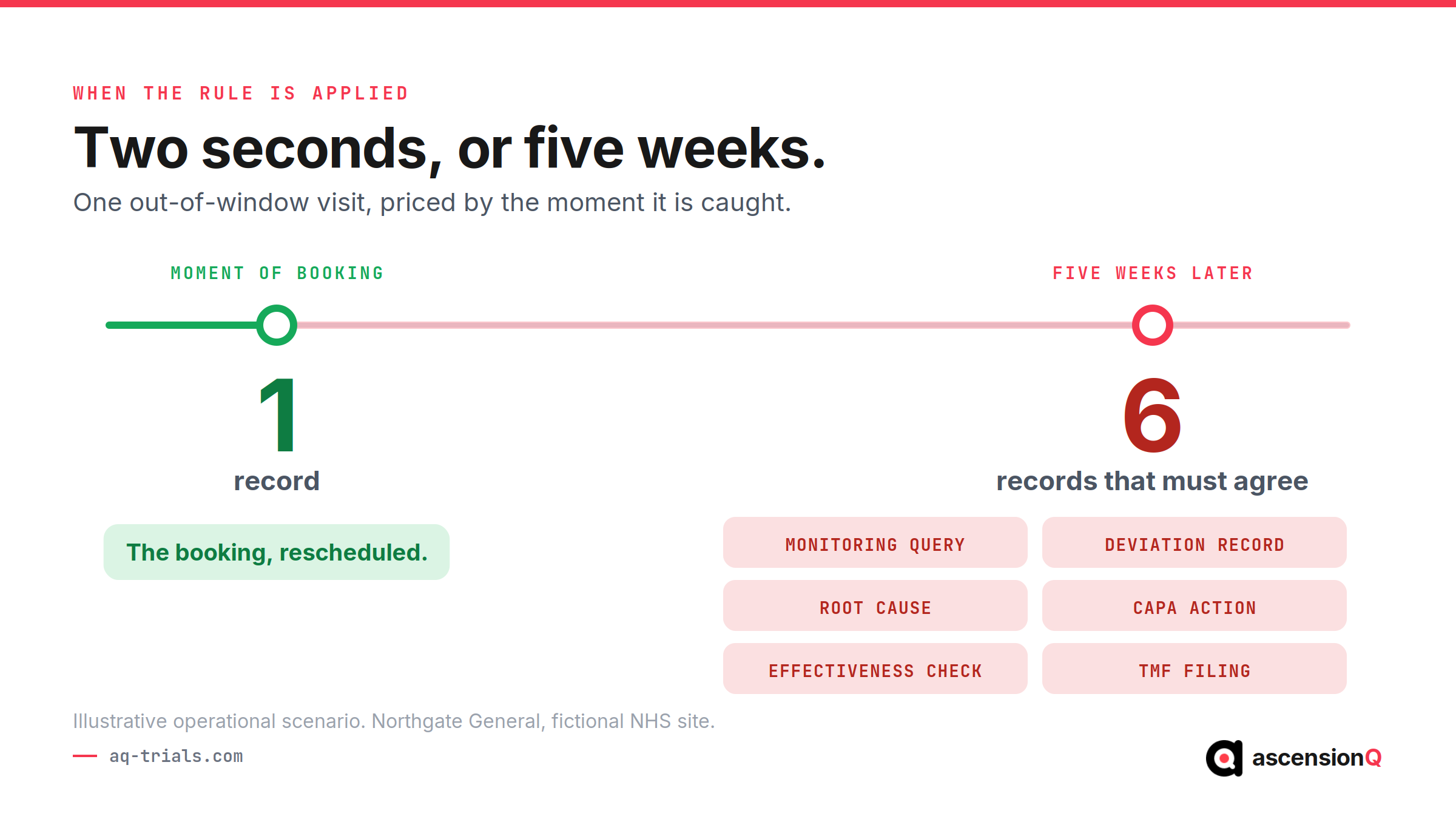
  • A delay occurs before Visit 2; the system flags it as an out-of-window risk and alerts Emma
  • Emma reschedules within the allowed window, and the system logs the activity with full traceability
  • Dashboards update in real time, showing enrolment progress, visit adherence, staff utilisation, and site capacity
 

This scenario shows how CTMS connects study setup, participant management, scheduling, communication, financial tracking, and compliance within one controlled system. Each activity follows protocol-defined rules and remains visible across the research team.

CTMS enables clinical trials to operate with structured execution, coordinated workflows, and continuous oversight across every stage of the study.

Also Read: How Much Does a Clinical Trial Management System Cost?

End-to-End CTMS Modules Across the Clinical Trial Lifecycle

CTMS operates as a connected system of modules that manage study execution, participant activity, documentation, compliance, and oversight across the clinical trial lifecycle.

Core CTMS Operational Modules

  • Study & User Management
    Defines study structure, assigns investigators and coordinators, and controls roles, permissions, and study access.
  • Participant Management
    Maintains participant records, enrolment status, clinical details, and study progression.
  • Study Scheduling & Visit Configuration
    Structures protocol-driven visits with defined time points, window periods, and cohort logic.
  • E-Planner (Appointment & Visit Management)
    Schedules and tracks participant visits using slot-based booking, calendars, and real-time availability.
  • Communication Management
    Automates email and SMS communication for booking confirmations, reminders, and study updates.
  • Financial Management (Payments & Costs)
    Tracks participant payments, visit compensation, and study-level cost allocation.
  • Capacity & Resource Management
    Manages site locations, rooms, staff allocation, and occupancy for efficient scheduling.

A CTMS supports multiple stakeholders across clinical research by aligning responsibilities, improving visibility, and maintaining structured execution across studies.

Stakeholder

Role in Clinical Trials

How CTMS Supports Them

Sponsors

Fund and oversee clinical trials, ensure timelines, budgets, and outcomes are met

Provides real-time visibility into study progress, financial tracking, and overall performance across sites

Contract Research Organizations (CROs)

Manage trial operations on behalf of sponsors across multiple studies and locations

Enables coordination across sites, standardises workflows, tracks milestones, and ensures consistent execution

Principal Investigators (PIs)

Lead clinical studies at sites and ensure protocol adherence

Offers structured view of participant progress, visit schedules, and study activities for controlled oversight

Study Coordinators

Handle daily trial operations including scheduling, participant management, and documentation

Supports visit scheduling, participant tracking, communication, and workflow management in one system

Clinical Research Associates (CRAs)

Monitor site performance, data accuracy, and compliance

Provides access to study data, visit tracking, audit logs, and site activity for monitoring and reporting

Site Staff (Nurses, Technicians, Support Staff)

Conduct study visits, manage participants, and perform clinical procedures

Aligns schedules, assigns tasks, tracks visit requirements, and ensures coordination across staff roles

Regulatory and Quality Teams

Ensure compliance with regulatory standards and manage documentation

Maintains audit trails, document control, and compliance workflows for inspection readiness

Data and Operations Managers

Oversee study performance, resource allocation, and reporting

Delivers dashboards, analytics, and operational insights for informed decision-making

What are the Advantages of Using a CTMS (Clinical Trial Management System)?

  • Centralised control over all clinical trial activities
  • Real-time visibility across participants, sites, and study progress
  • Structured study execution aligned with protocol requirements
  • Improved participant tracking and visit adherence
  • Efficient scheduling with reduced conflicts and delays
  • Automated communication for reminders and updates
  • Better coordination across teams and locations
  • Financial transparency with tracked payments and study costs
  • Strong compliance support with audit trails and role-based access
  • Reduced manual work through workflow automation
  • Faster decision-making with live dashboards and reports
  • Improved data accuracy and consistency across systems
  • Enhanced resource utilisation for staff and site capacity
  • Scalable operations across multiple studies and sites
  • Inspection readiness with complete traceability of study activities

How to Choose the Right CTMS Software?

Selecting a CTMS requires evaluating how well the system supports real study execution, compliance, and long-term scalability across clinical research operations. Key factors to consider include:

  • Study workflow alignmentAbility to configure study setup, visit schedules, protocol windows, and participant flow based on real trial requirements
  • User roles and access controlSupport for role-based permissions across investigators, coordinators, monitors, and sponsors
  • Participant and site managementCentralised tracking of enrolment, participant status, site activity, and workload distribution
  • Scheduling and visit managementStructured appointment planning with calendar views, slot management, cohort handling, and capacity control
  • Financial tracking and budgetingManagement of study budgets, participant payments, visit-based costs, and financial visibility across the trial
  • Compliance and audit readinessBuilt-in audit trails, electronic records management, and regulatory alignment embedded into everyday operations
  • Document and file managementSupport for eISF, eTMF, and document workflows with version control and access tracking
  • System integration — Ability to connect with QMS, ePSF, CAPA, and other clinical systems for a unified research environment
  • Reporting and analytics — Real-time dashboards for recruitment, visit adherence, site performance, and operational insights without manual compilation
  • Automation and communicationAutomated reminders, notifications, and workflow triggers that reduce manual coordination across sites and participants
  • ScalabilityCapacity to handle multi-site, multi-study environments as research operations grow without losing operational control
  • Usability and adoption — Intuitive interface and structured navigation that works across all user roles without extensive retraining
  • Data security and access management — Secure authentication, controlled access, and protection of sensitive participant and study data
  • Implementation and onboardingEase of setup, configuration, and transition into ongoing clinical trial workflows without disrupting active studies
  • Vendor reliability and supportOngoing technical support, system updates, and long-term product stability from a committed development team

What is AQ CTMS and How Does It Work?

Most research teams are not short of software. They are short of control — over where their study actually stands, whether their participants are on track, and whether what happened yesterday is documented well enough to withstand scrutiny tomorrow.

AQ CTMS is built around that reality. It is a clinical trial management system designed to give research teams a single operating environment where study execution, participant oversight, scheduling, financial tracking, and compliance run together — not across separate tools that need to be manually reconciled at the end of each week.

Study Setup That Drives Execution

A study configured in AQ CTMS becomes the operational backbone of the trial. Protocol schedules, visit windows, staff roles, payment values, and communication templates are defined once at setup and enforced consistently across every participant from that point forward. Protocol deviations rarely start with a deliberate decision — they start with a visit booked outside the window because someone was working from a printed schedule. AQ CTMS removes that ambiguity.

  • Protocol visit schedules, time points, and window periods configured and enforced at system level
  • Staff roles, delegation, and access boundaries defined per study and applied consistently
  • Participant payment values and cost structures set at setup and tracked automatically against execution
  • Communication templates built into the study, triggered by visit events without manual intervention
  • Protocol changes managed with full traceability — every update attributed, timestamped, and auditable

Participant Management With Full Lifecycle Visibility

From screening to study completion, every participant’s status, visit history, upcoming appointments, and progression against the protocol timeline is visible in one place — updated in real time as the study runs. Coordinators are not chasing confirmation emails or cross-referencing spreadsheets to answer a straightforward question about where a participant stands.

  • Participant screening, enrolment, and eligibility tracked within the study structure
  • Visit history, upcoming appointments, and attendance status visible per participant at all times
  • Recruitment pipeline and enrolment rates monitored against target — gaps surface before they become delays
  • Participant communications automated via SMS and email, reducing manual follow-up
  • Cohort and group-level tracking for studies with multiple arms or treatment schedules

Scheduling That Reflects How Sites Actually Work

Visit scheduling in AQ CTMS is protocol-driven and capacity-aware. Appointment windows are enforced during booking. Site room availability and staff workload are factored in real time. When a visit runs late or a participant needs to reschedule, the system flags the out-of-window risk, supports rescheduling within the allowed window, and logs every change with full context.

  • Visit windows enforced at point of booking — out-of-window scheduling flagged immediately
  • Site capacity, room availability, and staff workload factored into scheduling in real time
  • Automated participant reminders sent via SMS and email without manual coordination
  • Rescheduling logged with full context — the coordinator handles the situation, the audit trail handles itself
  • Missed visits and scheduling conflicts surfaced through live alerts and dashboard visibility

Financial Tracking Without the Reconciliation

Visit-level costs and participant payments are configured at study setup and tracked automatically against execution. Every completed visit updates the financial record. Spend against budget is visible within the same interface as operational activity — no separate finance spreadsheet running in parallel, no end-of-month reconciliation exercise.

  • Per-visit costs and participant payment obligations set at study level and tracked automatically
  • Cumulative spend updated in real time against study budget as visits complete
  • Financial data visible alongside operational dashboards within the same interface
  • Payment tracking maintained at both participant and study level throughout the trial

Operational Reporting Built Into the System

Study dashboards in AQ CTMS are live, not compiled. Enrolment progress, visit adherence, deviation history, staff utilisation, and site performance are available in one view, updated continuously as the study moves forward. Research teams do not prepare performance data for review — they present what the system has already been maintaining.

  • Live dashboards across enrolment, visit adherence, site performance, and staff utilisation
  • Deviation history, out-of-window activity, and protocol flags tracked and visible in real time
  • Reports exportable and structured for monitoring visits, sponsor oversight, and internal review
  • Operational and compliance data maintained continuously — no manual compilation before an audit

Compliance as the Default State

Every action in AQ CTMS is recorded — user identity, timestamp, activity detail — across studies, participants, schedules, and documents. Role-based access ensures team members operate within the boundaries their role defines. Inspection readiness is not a preparation task. It is what happens when a trial is run inside a system that records everything as a matter of course.

  • Comprehensive audit trails across every study action, participant record, and scheduling event
  • Role-based access control restricting system access to authorised personnel by study and function
  • Protocol execution controls preventing visits from proceeding outside defined rules without visibility
  • Deviation capture and structured reporting embedded into operational workflows
  • Inspection-ready records maintained continuously — exportable at any point in the trial lifecycle

Where AQ CTMS Stands Apart?

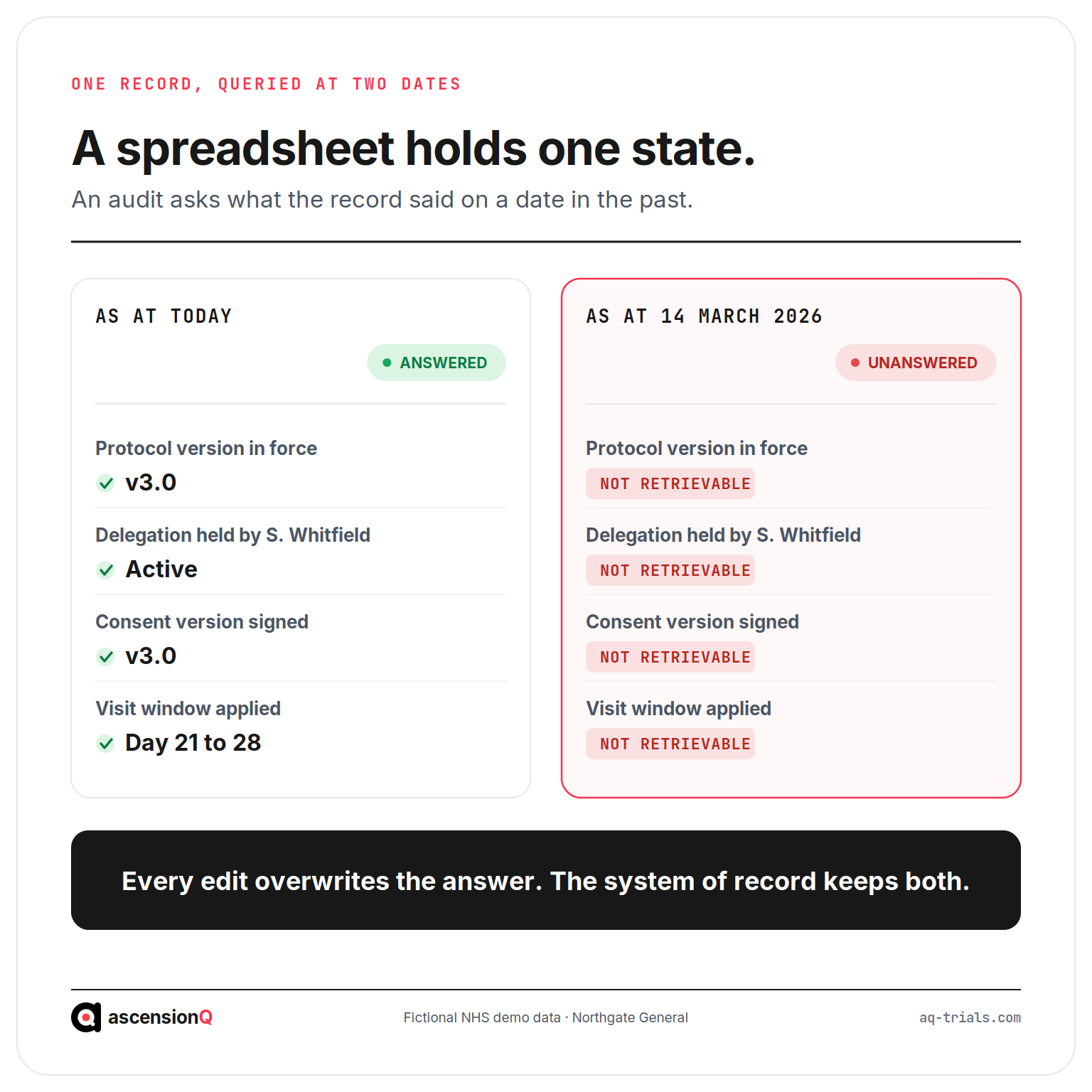
Traditional CTMS tools are built to record study activity. AQ CTMS is built to govern it. Visit windows are enforced, not just logged. Financial tracking runs alongside execution, not behind it. Compliance is embedded in how the system operates — not added as a reporting layer after the work is done.

Research teams using AQ CTMS are not managing their study across a CTMS, a document folder, a finance spreadsheet, and a deviation log. They are running it from one place — with a complete, traceable, inspection-ready record building itself in the background as they work.

That is the operational difference. And for teams preparing for MHRA inspection, sponsor oversight, or multi-site coordination, it is not a marginal one.

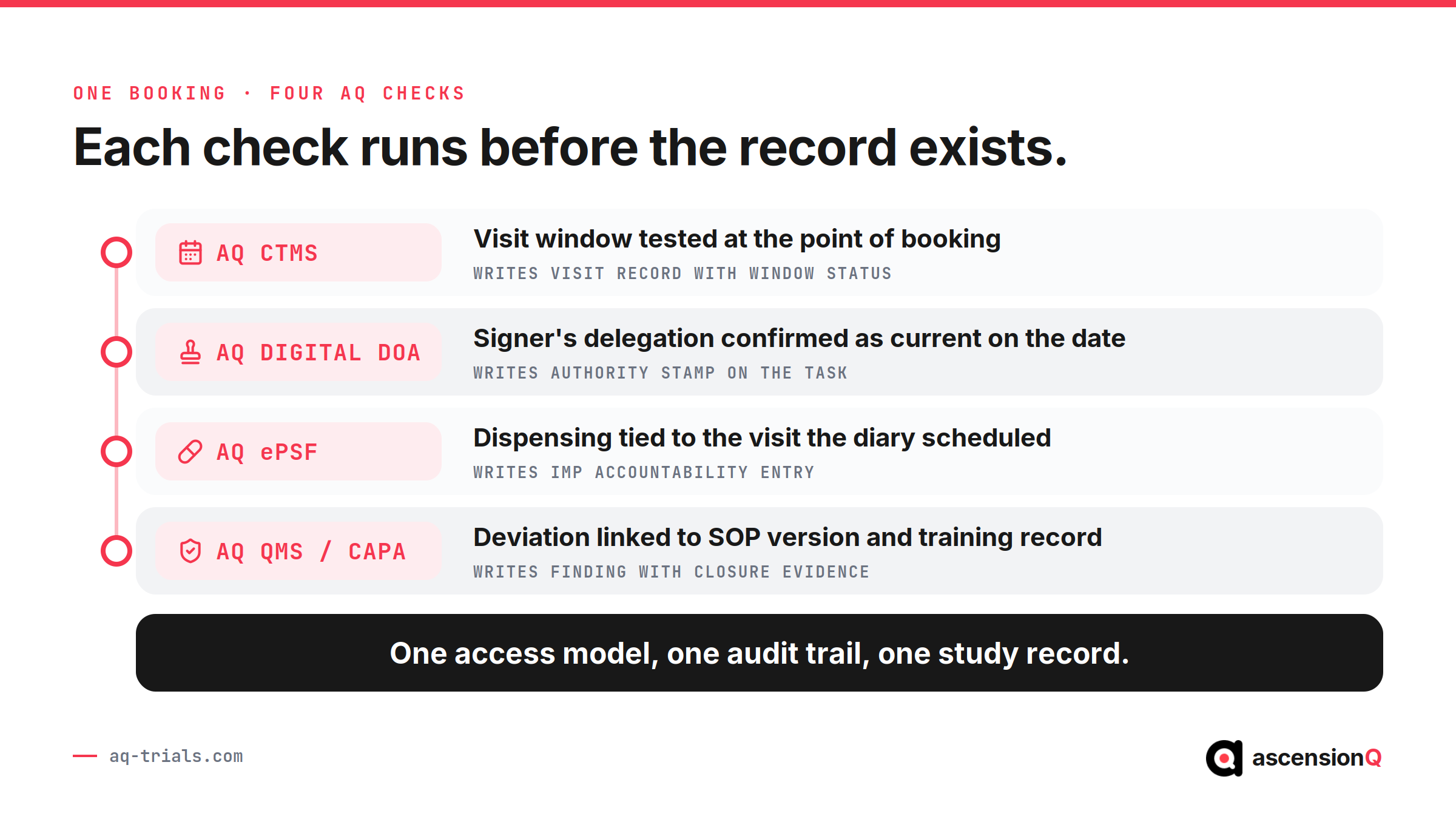
AQ CTMS is one part of a broader connected research platform. For organisations managing documentation governance, pharmacy oversight, quality management, and issue resolution alongside study execution — AQ brings eISF, ePSF, QMS, and CAPA into the same environment. One study record. One audit trail. One system.

CTMS and Compliance

Compliance is not a phase of a clinical trial. It runs through every action taken within it — from study setup and participant enrolment through to visit execution, documentation, and inspection.

A CTMS does not make a trial compliant. It creates the conditions under which compliance becomes the default operating state: structured access, continuous audit trails, protocol-aligned execution, and a traceable record of every decision made along the way.

The Regulatory Framework

AQ CTMS is built to support the standards that govern how trials are conducted, documented, and evidenced: ICH-GCP E6(R3), UK Clinical Trials Regulations, MHRA inspection expectations, and ALCOA+ data integrity principles. Participant data handling sits within the obligations of UK GDPR and the Data Protection Act 2018.

These are not optional frameworks. They define what regulators expect to see — and what research teams are accountable for producing.

How Compliance Is Built Into Study Operations?

Access control — Every user operates within a defined permission boundary. Study data, participant records, and operational actions are accessible only to those with authorised roles. Assignments are logged, time-stamped, and auditable.

Audit trails — Every action in the system is recorded with user identity, timestamp, and activity detail. The record is continuous, complete, and cannot be overwritten.

Protocol-driven execution — Visit schedules, time points, and window periods are enforced by the system, not left to manual interpretation. Deviations are flagged, logged, and reported automatically — not absorbed silently into the record.

Data integrity controls — Validated data entry, encrypted storage, version-controlled updates, and role-governed access ensure the study record remains accurate, attributable, and retrievable throughout the trial and into the retention period that follows.

Inspection Readiness

Inspection readiness is the outcome of running study operations within a controlled system from day one — not something assembled in the weeks before an audit.

AQ CTMS keeps the study record structured, attributable, and complete as a matter of course. When an inspector asks how a decision was made, how a visit was conducted, or how a deviation was handled — the evidence is already there.

Compliance Across Connected Modules

Compliance does not stop at study execution. It runs through documentation governance, quality management, issue resolution, and delegated authority:

  • AQ eISF — site document control, version governance, inspector access, and signature traceability
  • AQ ePSF — pharmacy documentation, investigational product accountability, and dispensing record traceability
  • AQ QMS — SOP control, training records, document approvals, and change governance
  • AQ CAPA — issue investigation, root cause analysis, corrective and preventive action, and closure evidence

Each module feeds a consistent compliance state into the next. The study record and the documentary record move together.

How Does CTMS Interact With Other Systems in Clinical Trials?

Clinical trials operate through multiple specialised systems, each managing a specific function. A CTMS connects these systems to ensure that study execution, data flow, documentation, and compliance remain aligned across the trial lifecycle.

CTMS acts as the operational hub that links activities across systems while maintaining a consistent view of study progress, participant activity, and site performance.

Key System Interactions

  • With Electronic Data Capture (EDC): CTMS aligns visit schedules, participant enrolment, and site activity with data collected during study visits. EDC captures clinical data, while CTMS tracks when and where that data is generated.
  • With Clinical Data Management System (CDMS)CTMS provides operational context such as visit timelines and participant status, while CDMS validates, cleans, and prepares collected data for analysis.
  • With Electronic Trial Master File (eTMF): CTMS links study activities with required documents. eTMF stores regulatory files, approvals, and trial documentation, ensuring completeness and inspection readiness.
  • With Quality Management System (QMS)CTMS tracks operational events, while QMS manages deviations, change control, CAPA processes, and quality workflows linked to those events.
  • With eISF (Electronic Investigator Site File): CTMS connects participant visits and site activity with investigator site documents, training records, and compliance files.
  • With Financial and Payment Systems: CTMS tracks study budgets, visit-based payments, and cost allocation, while external financial systems handle processing and accounting.
  • With Laboratory Information Management Systems (LIMS)LIMS is used to manage and track laboratory samples and test results. CTMS integration with LIMS allows for real-time tracking of sample collection and results. Well, this significantly helps in keeping a quick check on the progress of the trial while ensuring data accuracy at every step.
 

CTMS does not replace other systems. It connects them. Each system continues to perform its specialised function, while CTMS ensures that all activities remain coordinated, visible, and aligned within a single operational framework.

This interconnected approach enables clinical trials to run with structured execution, controlled data flow, and integrated oversight across every stage.

CTMS VS Other Clinical Trial Research Software

It is important to understand the difference between a unified CTMS system and other tools that clinical researchers use across the trial lifecycle, as each system serves a distinct purpose within study execution, data handling, compliance, and documentation.

CTMS VS EDC

Aspect

CTMS (Clinical Trial Management System)

Electronic Data Capture (EDC)

Primary Purpose

Manages clinical trial operations and study execution

Captures and stores clinical trial data from study visits

Focus Area

Operational management (sites, participants, visits, workflows)

Data collection and clinical data entry

Core Function

Plans, tracks, and coordinates study activities

Records patient data in electronic case report forms (eCRFs)

Data Type

Operational data (scheduling, enrolment, payments, site activity)

Clinical data (lab results, observations, outcomes)

Users

Study coordinators, investigators, sponsors, CROs

Site staff, data entry personnel, clinical data managers

Role in Workflow

Drives study execution and coordination across sites

Collects and structures data generated during study visits

Compliance Role

Tracks protocol adherence, audit trails, and operational oversight

Ensures accurate, validated, and structured clinical data capture

Integration

Integrates with EDC, eTMF, QMS, and other systems

Integrates with CTMS and CDMS for data flow and validation

Example Use

Scheduling participant visits and tracking study progress

Entering patient vitals, lab data, and clinical observations

Outcome

Provides visibility and control over trial operations

Provides clean, structured datasets for analysis and reporting

CTMS VS CDMS 

Aspect

CTMS (Clinical Trial Management System)

Clinical Data Management System (CDMS)

Primary Purpose

Manages clinical trial operations and execution

Manages, cleans, and validates collected clinical data

Focus Area

Operational workflows and study coordination

Data processing, validation, and quality control

Core Function

Tracks study progress, participants, visits, and site activity

Ensures data accuracy through validation checks, queries, and data cleaning

Data Type

Operational data (enrolment, scheduling, payments, site performance)

Clinical data (patient records, lab results, trial outcomes)

Users

Study coordinators, investigators, sponsors, CROs

Data managers, biostatisticians, clinical data teams

Role in Workflow

Drives execution and coordination of the trial

Prepares collected data for analysis and regulatory submission

Compliance Role

Maintains audit trails, protocol adherence, and operational oversight

Ensures data integrity, consistency, and validation against protocols

Integration

Connects with EDC, CDMS, eTMF, and QMS

Receives data from EDC and integrates with CTMS for context

Example Use

Monitoring recruitment progress and scheduling visits

Running data validation checks and resolving data discrepancies

Outcome

Provides visibility and control over trial operations

Produces clean, reliable datasets for statistical analysis

CTMS VS QMS 

Aspect

CTMS (Clinical Trial Management System)

Quality Management System (QMS)

Primary Purpose

Manages clinical trial operations and execution

Manages quality processes, compliance, and governance

Focus Area

Study workflows, participants, visits, and site coordination

Quality control, document approvals, audits, and CAPA processes

Core Function

Tracks and coordinates day-to-day study activities

Ensures processes follow defined quality standards and regulatory requirements

Data Type

Operational data (scheduling, enrolment, payments, site activity)

Quality and compliance data (deviations, change requests, audits, CAPA)

Users

Study coordinators, investigators, sponsors, CROs

Quality teams, compliance officers, auditors, management

Role in Workflow

Drives execution and operational control of the trial

Monitors and enforces quality across processes and documentation

Compliance Role

Maintains audit trails, protocol adherence, and operational visibility

Manages audits, document control, approvals, and corrective actions

Integration

Connects with QMS, EDC, eTMF, and other systems

Integrates with CTMS to align quality processes with study activities

Example Use

Scheduling visits and tracking participant progress

Managing deviations, approving documents, handling change control

Outcome

Ensures studies run efficiently and according to plan

Ensures studies meet quality standards and regulatory expectations

CTMS VS eTMF 

Aspect

CTMS (Clinical Trial Management System)

Electronic Trial Master File (eTMF)

Primary Purpose

Manages clinical trial operations and execution

Manages and stores essential trial documents and records

Focus Area

Study workflows, participants, visits, and site coordination

Document collection, organisation, and regulatory documentation

Core Function

Tracks and coordinates study activities across sites and teams

Maintains complete, version-controlled trial documentation for compliance

Data Type

Operational data (enrolment, scheduling, payments, site activity)

Regulatory documents (protocols, consent forms, approvals, reports)

Users

Study coordinators, investigators, sponsors, CROs

Regulatory teams, document specialists, sponsors, auditors

Role in Workflow

Drives execution and operational visibility of the trial

Ensures all required documents are complete, organised, and inspection-ready

Compliance Role

Maintains audit trails, protocol adherence, and activity tracking

Ensures document completeness, version control, and regulatory compliance

Integration

Connects with eTMF, EDC, QMS, and other systems

Integrates with CTMS to link documents with study activities

Example Use

Scheduling visits and tracking study progress

Storing investigator brochures, ethics approvals, and study documents

Outcome

Provides control and visibility over trial execution

Provides a complete, auditable record of trial documentation

CTMS VS Excel 

Aspect

CTMS (Clinical Trial Management System)

Microsoft Excel

Purpose

Executes and manages clinical trial operations

Tracks data manually in spreadsheets

Approach

System-driven workflows with defined processes

User-driven tracking without built-in structure

Data Handling

Centralised, connected, and continuously updated

Static, file-based, and manually updated

Study Execution

Supports scheduling, participant tracking, and site coordination

Requires manual tracking across multiple sheets

Visibility

Real-time dashboards across studies, sites, and participants

Limited visibility confined to individual files

Collaboration

Multi-user access with role-based permissions

File sharing with version conflicts and duplication risks

Compliance

Built-in audit trails, access control, and traceability

No native compliance controls or audit tracking

Error Control

Validation rules and automation reduce operational errors

High risk of manual errors and inconsistencies

Scalability

Handles multi-site, multi-study environments efficiently

Becomes difficult to manage as complexity increases

Integration

Connects with EDC, QMS, eTMF, and other systems

Operates as a standalone tool with limited integration

Outcome

Structured, controlled, and scalable trial execution

Basic tracking with limited control and oversight

Explore AQ CTMS Now

Book a live demonstration to explore how AQ CTMS streamlines study execution through connected study management, participant oversight, visit coordination, operational reporting, and real time trial visibility.

We can also show you how AQ brings CTMS, eTMF, eISF, ePSF, QMS, and CAPA management together on one integrated platform for complete research operations.

Share

Table of Contents

Screenshot_2026-06-27_210857-removebg-preview
15+ guides

Free guides · PDF

Guides matched to you.

Written for first-in-human & Phase 1 sites

Inspection-ready checklists & templates

Aligned to MHRA, FDA & EU Annex 11

Stay updated with guides, platform news, and regulatory insights.

No spam. Unsubscribe at any time.

Explore

Screenshot_2026-06-27_210857-removebg-preview

15+ guides

Free guides · PDF

Guides matched to you.

Written for first-in-human & Phase 1 sites

Inspection-ready checklists & templates

Aligned to MHRA, FDA & EU Annex 11

Free guides · PDF
Find the right guide for you

Pick a module, your organisation type, or both — we'll match the guides and email them to you.

Most popular guides