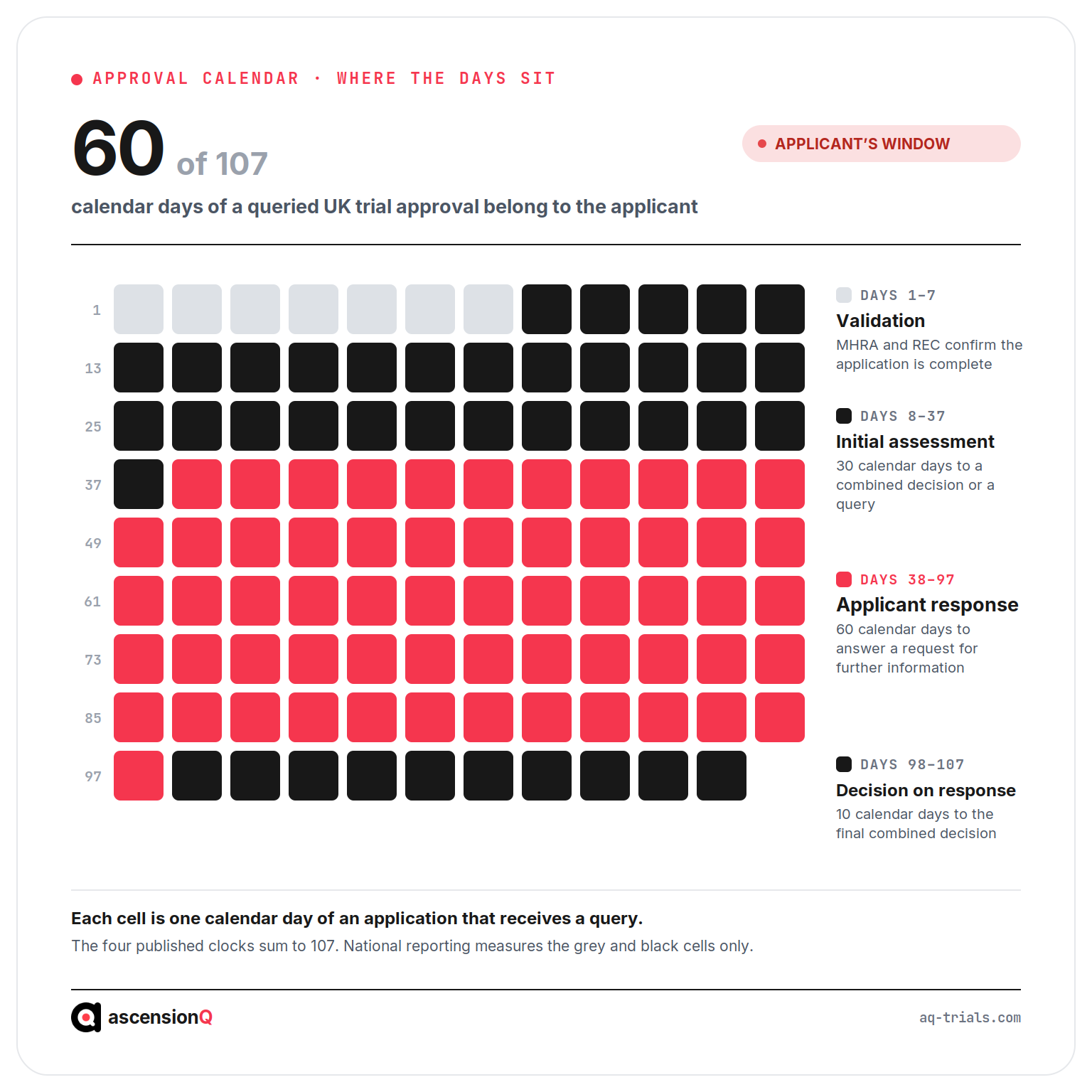
A UK clinical trial application runs against four published clocks. Validation completes within 7 calendar days of submission, the initial combined review decision follows within 30 calendar days of validation, an applicant answering a request for further information has up to 60 calendar days, and the decision on that response arrives within 10 calendar days. The four figures sum to 107 calendar days from submission to a final combined decision.
Three of those clocks belong to the Medicines and Healthcare products Regulatory Agency and a Research Ethics Committee. One belongs to the applicant, and it is the longest of the four. The MHRA states that more than half of all applications require additional information before they are considered approvable, so the applicant’s 60 day window is the usual path rather than the exception.
This guide sets out every published clock in the UK approval pathway, what starts and stops each one, how validation can reset an application to day zero, why the majority of applications attract a request for further information, the faster route available to lower-risk trials, the timelines that apply to modifying an approved trial, and the statutory deadlines that begin the day approval arrives.
Key takeaways
- The published assessment period is 30 calendar days from validation, and the applicant’s response window is 60 calendar days. The longer clock sits with the sponsor.
- Validation runs on a 7 calendar day limit from submission. An unresolved deficiency makes the application invalid and forces a resubmission at day zero.
- The MHRA publishes that up to 95% of applications are approved and that more than half require additional information first.
- Lower-risk trials meeting Condition A, B or C receive confirmation of automatic authorisation within 14 calendar days of validation, with the combined decision inside 30.
- Independent expert advice extends the initial review to 120 calendar days and a response review to 40 or 70 calendar days.
- A substantial modification runs to 35 calendar days from validation. A Route B substantial modification carries a 14 calendar day determination for automatic licensing authority approval.
- Approval starts its own clocks: the first UK participant within 2 years, public registration before the first consent signature, and a results summary within 12 months of the end of trial.
What Are the Published MHRA Clinical Trial Approval Timelines?
The MHRA and a Research Ethics Committee assess a clinical trial of an investigational medicinal product together through combined review. One application goes through the Integrated Research Application System, both bodies review in parallel, and one combined decision comes back. Each stage of that process carries a published limit, and the limits differ in who owns them.
| Stage | Published clock | Who holds it | What starts it |
|---|---|---|---|
| Validation | 7 calendar days, with deficiencies identified by day 5 | MHRA and REC | Submission through IRAS |
| Initial assessment | 30 calendar days | MHRA and REC | Confirmation that the application is valid |
| Response to a request for further information | Up to 60 calendar days | The applicant | The date the decision letter was issued |
| Decision on the response | 10 calendar days | MHRA and REC | The date the response was submitted |
| Initial assessment with independent expert advice | 120 calendar days | MHRA and REC | Confirmation that the application is valid |
| Response review with independent expert advice | 40 calendar days, or 70 for advanced therapy products | MHRA and REC | The date the response was submitted |
| Notice of intention to appeal a refusal | 28 calendar days | The applicant | Receipt of the decision |
The published figures describe assessment time rather than elapsed time. A trial that reaches approval in four calendar months can still report a compliant 30 day assessment, because the clock stops while the applicant prepares a response. The same distinction shapes the national reporting figures, and it explains why the combined review indicator sits at 98% against a 99% target while sponsors describe approval as slow.
What Happens During Validation, and What Makes an Application Invalid?
Validation is the check that an application is complete enough to assess. The Health Research Authority states that validation checks take one working day, and gov.uk guidance states that the outcome reaches the applicant by email and through IRAS within 7 calendar days of submission, with deficiencies identified by day 5 at the latest. The assessment clock does not start until validation passes.
- The deficiency notice arrives early in the window. Identification by day 5 leaves two days to respond, so the person who can fix a document has to be available in that week rather than the following one.
- The 7 day limit runs from the initial submission. The clock counts from the day the application was made, so time spent locating the right version of a document consumes the same window.
- An unresolved deficiency invalidates the application. The HRA states that the sponsor would need to resubmit and address the validation issues, which returns the study to day zero.
- Specialist reviews are settled before this point. Pharmacy and radiation questions run through HRA Technical Assurance ahead of the ethics application, so a late specialist question becomes a validation problem.
A worked example shows the cost. A sponsor submits on a Monday and receives a validation deficiency on the following Friday, naming a protocol version mismatch between the cover letter and the uploaded document. The correct version sits with a chief investigator on annual leave. The application lapses on day 7, the sponsor resubmits eleven days later, and the study has lost eighteen calendar days without a single assessor having read the protocol.
Validation measures the file, not the science.
Which Clock Belongs to the Applicant?
The central asymmetry of the UK approval pathway is a 30 day regulator clock set against a 60 day applicant clock. Both are published, both are legitimate, and only one of them appears in performance reporting. A sponsor planning a set-up schedule against the 30 day figure alone will plan for the shorter half of the process.
| Aspect | The regulator’s clock | The applicant’s clock |
|---|---|---|
| Published length | 30 calendar days for the assessment, 10 for the decision that follows a response | Up to 60 calendar days to answer a request for further information |
| Reported nationally | Yes, as the combined review indicator | No. The clock stops while the response is prepared |
| Who controls the duration | The MHRA and the Research Ethics Committee | The sponsor, the chief investigator and the manufacturing team |
| Effect of an extension | Independent expert advice takes the initial review to 120 calendar days | An advanced therapy response review runs to 70 calendar days |
| Consequence of overrun | A published performance figure moves | The application is treated as withdrawn |
| Where the evidence sits | IRAS and the regulator’s own record | The sponsor’s study record, or nowhere |
The second row carries the operational weight. Published UK indicators measure regulator assessment time, and the methodology states that the clock stops once a request for further information is sent and starts again once a complete response is submitted. The applicant’s days are real calendar days for every site waiting to open, and they sit outside the published set-up figures entirely.
Why Do More Than Half of Applications Receive a Request for Further Information?
The MHRA publishes its own answer. Guidance on common issues identified during clinical trial applications states that the great majority, up to 95%, of applications are approved, and that more than half require additional information to be submitted before they are considered approvable. Points raised in that way are called grounds for non-acceptance.
The same guidance quantifies the delay and groups the causes into four assessment areas.
- Validation issues cover the submission itself, including document sets, version alignment and the completeness of the application, which is the category most fully inside a sponsor’s control.
- Non-clinical issues cover preclinical safety and pharmacology, where the supporting package has to justify the proposed starting dose and exposure.
- Clinical issues cover trial design and safety reporting, including eligibility, stopping rules and the arrangements for managing adverse events.
- Pharmaceutical issues cover manufacturing and product quality, where specification, stability and labelling evidence has to match the product actually being supplied.
The MHRA states that its initial assessment takes approximately 12 days for a phase 1 application and approximately 22 days for other phases, and that grounds for non-acceptance can add up to 21 days to a phase 1 approval and 23 days to other phases, depending on how long the applicant takes to respond and how long the assessment of that response takes. The agency is explicit that its guidance is not a tick-box exercise and that an acceptable scientific safety justification may avoid a finding.
Also Read: UK Clinical Research Delivery KPIs: What the Data Says About Trial Set-Up
How Fast Is the Notification Scheme for Lower-Risk Trials?
The notification scheme gives lower-risk trials a faster licensing authority route. Confirmation of automatic approval from the licensing authority is issued within 14 calendar days of validation, and the initial combined decision, which carries the ethics opinion as well, is issued within 30 calendar days of validation. A trial cannot start on the automatic authorisation alone, so the 30 day figure is the one that belongs in a set-up plan.
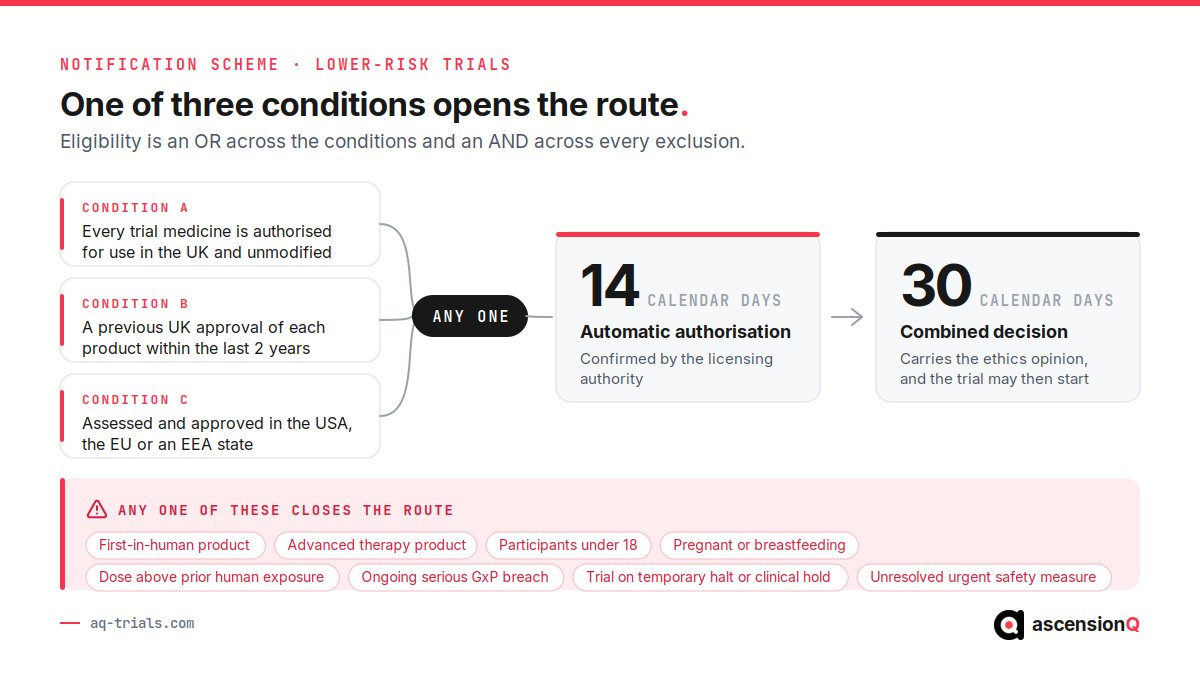
Eligibility rests on meeting one of three published conditions and on none of the exclusion criteria applying. The conditions describe three different kinds of prior evidence.
- Condition A covers licensed products. All investigational medicinal products are authorised for use in the UK and unmodified, and each is used according to its authorisation or in established practice supported by sufficient published evidence or guidelines.
- Condition B covers recent UK approval. A previous trial of each product, including placebos, was approved in the UK within the last 2 years and was not a first-in-human trial, matching on dose, frequency, duration, route, indication and manufacturing process.
- Condition C covers approval elsewhere. The trial is not first-in-human and has been assessed and approved in the USA, the EU or an EEA state using the same protocol and Investigator’s Brochure versions.
The exclusion list closes the route on grounds that are largely about the product and the population. Published exclusions include any first-in-human product, an advanced therapy medicinal product, participants under 18, pregnant or breastfeeding, dosing above what has previously been tested in humans, post-marketing regulatory restrictions, other trials on temporary halt or clinical hold, unresolved urgent safety measures, ongoing serious breaches of GxP by the sponsor, pivotal non-clinical toxicology conducted outside an OECD Mutual Acceptance of Data member country, and known or suspected impurity concerns in healthy volunteer trials.
Applicants complete a confirmation of notifiable trial criteria form, state in the cover letter that the application is for a notifiable trial, submit the standard documentation, and provide the evidence specific to the condition claimed. The classification carries a documented justification, which an inspector can ask to see later.
What Are the Timelines for Modifying an Approved Trial?
Modification replaced amendment as the operative term under the amended UK Clinical Trials Regulations, and the categories carry very different clocks. A change that looks administrative to a study team can sit in the 35 day category, and a change that feels significant can require nothing more than a record.
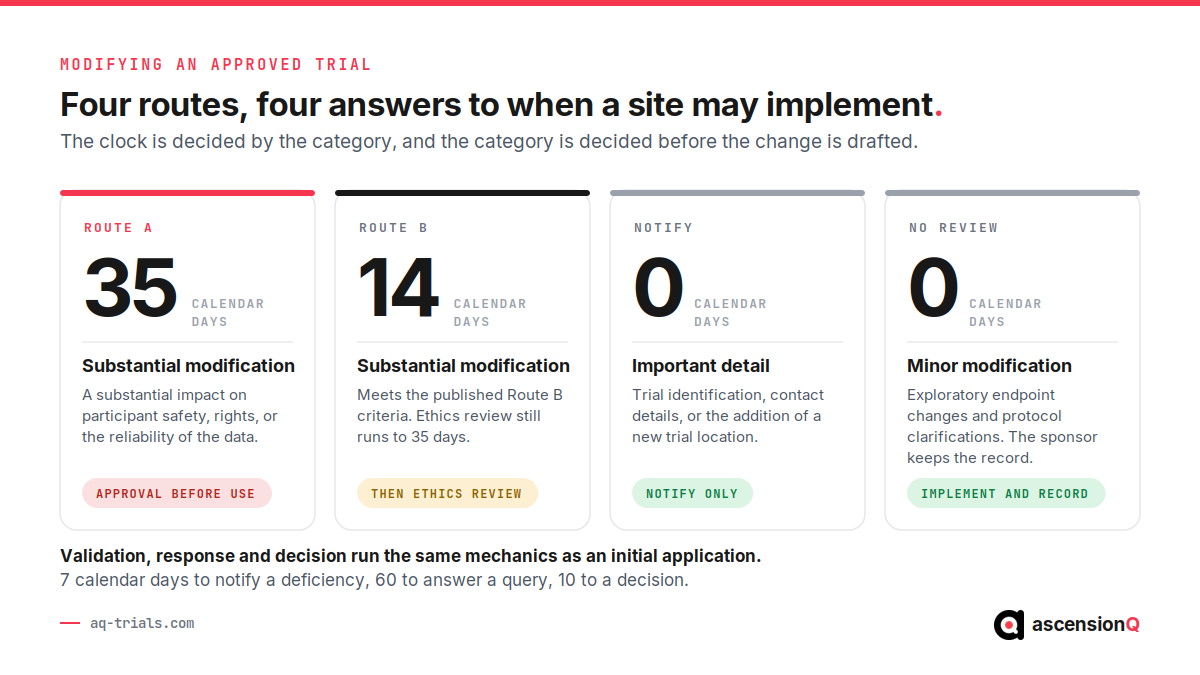
- A Route A substantial modification runs to 35 calendar days from validation. The change is likely to have a substantial impact on participant safety or rights, or on the reliability or robustness of the data, and it requires approval from both the licensing authority and the ethics committee before implementation.
- A Route B substantial modification carries a 14 calendar day determination. A modification meeting the published Route B criteria receives automatic licensing authority approval on that clock, and the 35 day period still applies where ethics review is required.
- A modification of important detail carries no review period. Trial identification changes, contact detail updates and the addition of a new trial location are notified rather than approved.
- A minor modification carries no notification duty. Exploratory endpoint changes and protocol clarifications are implemented when the sponsor decides, and the sponsor keeps the record.
Modifications run the same validation and response mechanics as an initial application. Deficiencies are notified within 7 calendar days, an applicant answering a request for further information has 60 calendar days, and the decision follows within 10. The MHRA ran a Route B notification pilot from 1 October 2025 to 31 March 2026, ahead of the regulations taking full effect on 28 April 2026.
The operational cost of a substantial modification lands after the approval rather than during it. Re-consent, re-training, updated site file versions and a revised pharmacy set-up follow at every participating site, and none of that work carries a published clock.
What Happens If an Application Is Refused?
An adverse decision carries a defined appeal route with its own timings, and the first of them is short. Guidance states that an applicant has 28 calendar days from receiving the decision to send written notice of an intention to appeal to the Health Research Authority appeals address.
- The notice period is 28 calendar days from receipt of the decision. A missed notice period closes the appeal route and leaves resubmission as the only option.
- Representations follow on a much longer period. An applicant then has 6 months to provide representations, extendable to 12 months.
- Resubmission returns the study to validation. A new application starts a fresh 7 day validation window and a fresh 30 day assessment period.
The asymmetry between 28 days and 6 months is worth planning around. The decision to appeal has to be taken quickly, and the case supporting it can be built afterwards.
Which Clocks Start the Day Approval Arrives?
Approval ends one set of clocks and starts another. The amended regulations, in force since 28 April 2026, attach statutory deadlines to the study itself, and a study that misses one loses either the approval or the compliance position behind it.
| Duty | Deadline | What the study record has to hold |
|---|---|---|
| Recruit the first UK participant | Within 2 years of approval, with extensions available | The approval date and the first participant date, per trial. The approval lapses without recruitment or an extension. |
| Register the trial publicly | Before the first participant gives consent, or within 90 days of approval, whichever comes first | A registry entry and its reference, held against the approval date the second limb runs from |
| Register an older trial ending on or after 28 April 2026 | Within 90 calendar days of 28 April 2026 where recruitment had already started | Evidence of registration under the transitional arrangements |
| Declare the end of trial | Within 90 days of the global end, or 15 days of a global premature end | A reliable end of trial date and the milestone history behind it |
| Publish a summary of results | Within 12 months of the end of trial | The trial end date, the registry entry and the outcome data |
| Report a fatal or life-threatening SUSAR | No later than 7 days from awareness, with follow-up within 8 days | The date of awareness, distinct from the date of the event |
Every one of those deadlines runs from a date somebody has to be able to produce. The 2 year recruitment condition needs an approval date and a first participant date on the same record. The registration duty needs a registry reference, the approval date and the date of the first consent signature, because the deadline is whichever of the two limbs falls first. A team holding those dates in separate trackers converts each deadline into a reconciliation task.
Also Read: NHS Clinical Research Software and ICH-GCP E6(R3): What the New UK CTR Requires
What Should a Sponsor Hold to Meet These Clocks?
Approval timelines reward preparation rather than pressure. Five practices shorten the part of the pathway a sponsor controls, and each one works by removing a search from a deadline.
- Freeze the document set before submission. One version of the protocol, the Investigator’s Brochure and the cover letter, agreed and dated, removes the version mismatch that causes most validation deficiencies.
- Name a response owner at submission. A request for further information arrives on a 60 day clock, and an owner appointed in advance starts drafting on day 1 rather than on day 14.
- Run site set-up in parallel with assessment. Contracting, costing and capacity and capability confirmation proceed while the application is under review, which prevents the sequence that pushes sites past the 90 day set-up target.
- Record the regulatory dates as milestones, not as emails. Submission, validation, decision, response and approval dates held against the study support national reporting through CPMS and a local system and answer an inspector years later.
- Classify modifications before they are drafted. A change assessed against the three categories at the point it is proposed lets a team plan for 35 days, 14 days or none of them, rather than discovering the category after the protocol has been rewritten.
The regulator publishes its clock. The sponsor has to publish its own.
Also Read: How Long Do Clinical Trials Take?
How Does AQ Hold the Approval Timeline as a Study Record?
AQ Platform holds the regulatory dates, the documents behind them and the site set-up that runs alongside them on one study record, so a timeline is read from the system rather than reconstructed from correspondence.
- AQ CTMS records submission, validation, decision, response and approval as dated milestones with owners, which turns the 2 year recruitment condition and the 150 day set-up standard into figures a research office reviews weekly.
- AQ eTMF and AQ eISF hold the submitted document versions in one structure, so a modification reaches the trial master file and every site file against the same index and a version mismatch surfaces before submission.
- AQ ePSF ties pharmacy readiness to the approved protocol version, which is what a substantial modification landing mid set-up puts at risk.
- AQ QMS and AQ CAPA link SOP versions, training records and findings, which evidences the state of the quality system on the date a regulator asks about.
- AQ Digital DoA keeps delegation, qualifications and dates current, so a staffing change during a 60 day response window costs an update rather than a rebuild.
AQ does not shorten a regulator’s assessment period, and no system does. It gives a sponsor or an NHS research office one dated view of the days it owns, which is the half of the pathway that no published indicator reports. AQ is aligned with Good Clinical Practice, UK GDPR and 21 CFR Part 11, and assurance covers G-Cloud, DSPT and Cyber Essentials.
Book a live demo and the walkthrough runs on your own submission, response and set-up dates. Bring a study in set-up now and use the session to map where its calendar is going.
Frequently Asked Questions
How long does MHRA clinical trial approval take in 2026?
Validation completes within 7 calendar days of submission and a combined decision follows within 30 calendar days of validation. An application that attracts a request for further information adds up to 60 calendar days for the applicant’s response and 10 calendar days for the decision on it, giving a published maximum of 107 calendar days.
Does the approval clock stop while the sponsor answers a query?
Yes. The published assessment period covers regulator time, and the applicant’s response window sits outside it. National reporting applies the same rule, so an approval reported as compliant on a 60 day indicator can have taken several calendar months in practice.
What is the fastest UK route to a clinical trial approval?
The notification scheme is the fastest route. A trial meeting Condition A, B or C, with none of the exclusion criteria applying, receives confirmation of automatic licensing authority approval within 14 calendar days of validation, and the combined decision including the ethics opinion within 30 calendar days.
How long does a substantial modification take to approve?
A Route A substantial modification is decided within 35 calendar days of validation, and both the licensing authority and the ethics committee approve before it is implemented. A Route B substantial modification carries a 14 calendar day determination for automatic licensing authority approval where the published criteria are met.
What happens if a UK trial approval is not used?
The amended regulations expect a first UK participant within 2 years of approval, with extensions available. An approval that reaches 2 years without recruitment and without an extension lapses, so the approval date and the first participant date need to sit on a record somebody reviews.
Sources
- Clinical trials for medicines: apply for approval in the UK (GOV.UK)
- Combined review: initial application timeframes and process (Health Research Authority)
- Clinical trials for medicines: notifiable trials (GOV.UK)
- Clinical trials for medicines: modifying a clinical trial approval (GOV.UK)
- Common issues identified during clinical trial applications (GOV.UK)
- Clinical trials regulations: transitional arrangements (GOV.UK)