The best clinical trial software for Phase 1 units in the UK is the system that records a dosing day at minute precision: nominal and actual times, the dose cohort, sample chain of custody, pharmacy accountability and delegation, all on one record. Most platforms named for this question are sponsor-side data capture tools.
That mismatch is the problem. A Phase 1 unit runs healthy volunteers through intensive dosing days, takes pharmacokinetic samples on a schedule measured in minutes, and holds the safety record a review committee reads before the next cohort opens. An electronic data capture system answers to the sponsor. The unit still has to run itself.
This guide records what each named vendor publishes about its own product, sets out the record set a Phase 1 unit carries beyond a general clinical trial management system, and maps the shortlist to three kinds of UK unit. The study type itself is defined in the guide to what a Phase 1 clinical trial is.
Best Clinical Trial Software for Phase 1 Units in the UK: The 2026 Comparison
The ten platforms below are those AI assistants name most often for this question, listed alphabetically. Every statement comes from the vendor’s own product pages, checked 3 November 2026. A cell reading “not stated” means the vendor’s own site does not say it, which is a finding rather than a fault. No prices appear here. Licence cost is covered in the guide to clinical trial management system cost.
| Platform | What the vendor calls it | What it covers, as the vendor states it | Early phase, as stated | Hosting and validation, as stated |
| AQ Platform | Connected clinical research operations across nine modules | CTMS, eISF, eTMF, Pharmacy, Labs, eSource, QMS, CAPA and Digital DoA on one study record | AQ Labs names Phase 1 units among the organisations it serves, alongside NHS trusts, CRDC hubs and spokes and CROs | UK-hosted. NHS DSPT Standards Met (2026), Cyber Essentials certified, ISO 27001-aligned controls. Validated to GxP standards every release, covering IQ, OQ, PQ and a 21 CFR Part 11 and EU Annex 11 assessment. Fits a UK Phase 1 or early phase unit that runs its own dosing days, pharmacy and samples and wants all three on the study record an inspector reads |
| Castor | An AI-native clinical trial platform | EDC, CDMS, eCOA and ePRO, eConsent, and Catalyst, which extracts source data for a reviewer to confirm | “From first-in-human to post-market, one platform”. Phase 1 is not named | Hosting region not stated. Badges cite ISO 27001, ISO 9001, 21 CFR Part 11, ICH GCP and GDPR |
| ClinSpark | An EDC platform for early-phase studies with integrated eSource workflows | Combined eSource and EDC, direct bedside entry and targeted source data review | “Purpose-built for early-phase clinical studies”, deployed across all four Fortrea clinical research units | Hosting not stated. No standard or validation claim named. A registered trademark of IQVIA |
| EDGE | A cloud-based clinical trials management system from the Clinical Informatics Research Unit, University of Southampton | Project workflows, finance tracking, document and staff management, patient management, an electronic delegation log and reporting | Not stated | Cloud-based, no region named. No validation claim stated |
| Medidata | Rave, described as the leading electronic data capture system | Rave EDC, Rave Companion for EHR population, Designer for study build and Clinical Data Studio | Rave Lite is “tailored for Phase I, Phase IV, and medical device post-market studies” | Hosting region not stated. No regulation or certification named on the EDC page |
| Medrio | “The Only EDC for Small and Scaling Clinical Teams” | EDC and CDMS, eCOA and ePRO, eConsent, RTSM, CTMS and eTMF, configurable without a programmer | “Supports research from early phase to post-market”. Phase 1 is not named | Hosting not stated. Claims “a fully validated, audit-ready EDC”, naming no standard |
| OpenClinica | An electronic data capture platform built on dynamic eCRFs | Drag-and-drop study build, site and user management, randomisation, electronic signatures and a monitor dashboard | Not stated | “Optimized Cloud”, no region named. States compliance with GCP and 21 CFR Part 11, plus SOC and ISO 27001 |
| RealTime-CTMS | The operational core of RealTime SOMS, for research sites and site networks | Visit scheduling with automatic window calculation, recruitment and financials, with eReg, eISF and eSource as companion products | CTMS carries no Phase 1 description. The separate eSourceOne product is “purpose built platform for phase I” | “Regional data residency” stated, no region named. Badges cite SOC 2 and HIPAA |
| Veeva SiteVault | A site-first solution combining CTMS, eISF and eSource | SiteVault CTMS for patient activity, eISF for study binders and remote monitoring, eConsent, and eSource listed as coming soon | Not stated | Hosting region not stated. No validation standard named |
| Viedoc | An EDC platform with a study designer for teams making their own changes | EDC, ePRO, televisits, randomisation, trial supply management and medical coding | Serves trials “From rare disease to oncology, Phase I to post-market” | Hosting region not stated. Cites built-in 21 CFR Part 11, GDPR, SOC 2 and ISO 27001 compliance |
Three patterns come out of the set. Two products are built for early phase by their own description, and both are data capture rather than unit operations. Seven of the ten publish no hosting region, a procurement question at an NHS research facility. One names Phase 1 units on a module page. The method behind a comparison like this sits in the guide to choosing clinical research software.
What Does a Phase 1 Unit Need That a General CTMS Lacks?
A later phase visit is recorded against a date and a window. A Phase 1 dosing day is recorded against a clock. One blood draw at two hours post-dose carries a nominal time, an actual time, the gap between them, the cohort and dose, the person who drew it under a current delegation, the aliquot identifiers, the processing start, the freezer location and the handovers.
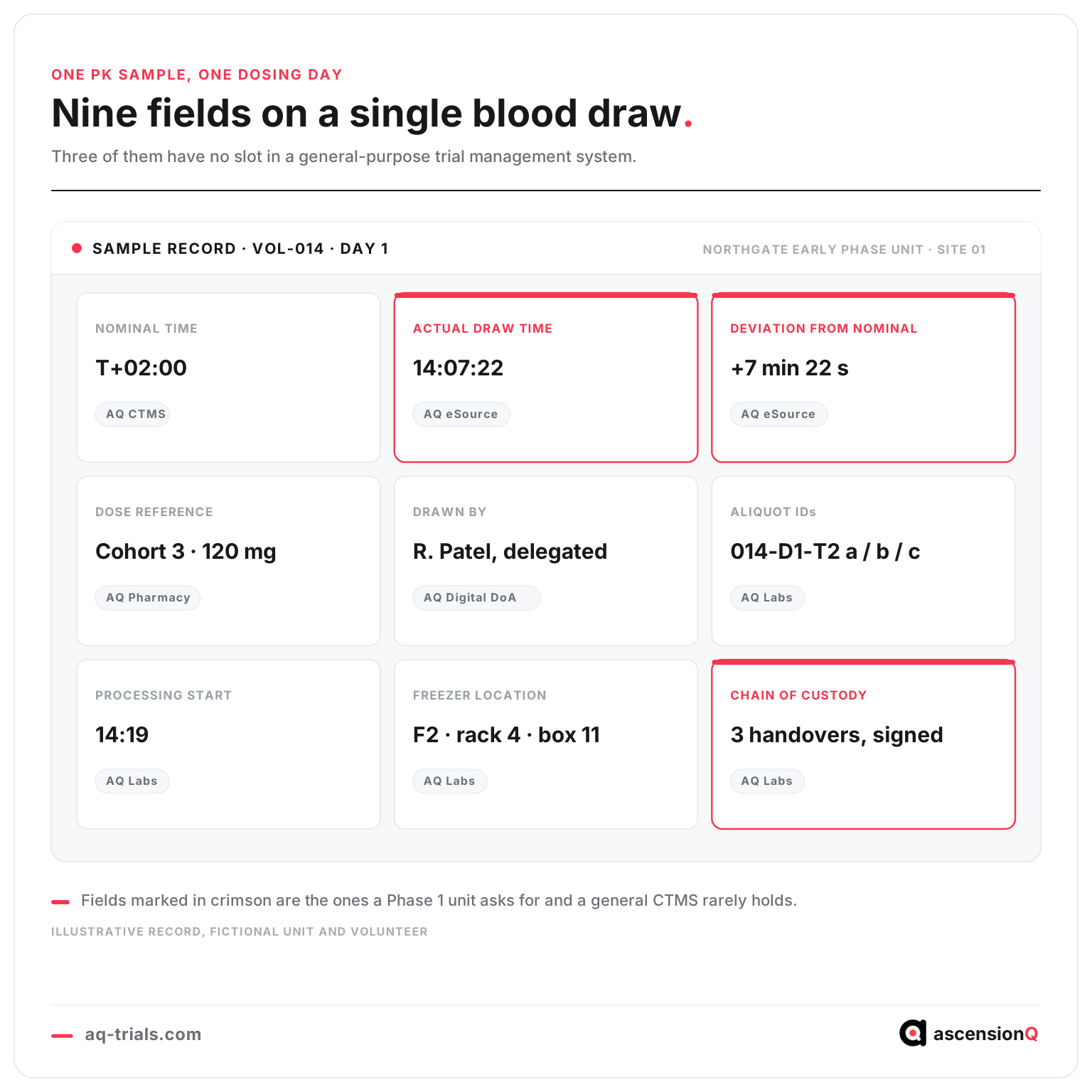
Six capabilities separate a Phase 1 unit’s requirement from a general site platform. Each maps to a record somebody eventually asks to see.
- Volunteer panel and identity checks. A unit recruits from a standing panel rather than a clinic population, so the system holds registration, screening history and an over-volunteering check before booking.
- Residential scheduling. Overnight stays, multi-day confinement and staggered dosing slots sit badly in a calendar built for outpatient windows, so the scheduler carries bed occupancy and staffing alongside the visit.
- Cohort and dose structure. Participants belong to a cohort and a dose level, and the record groups them that way for every safety and pharmacokinetic report.
- Pharmacy at unit tempo. An investigational medicinal product (IMP) is often dispensed and dosed within the hour, so receipt, storage, dispensing and reconciliation keep pace with the dosing room.
- Sample handling as a governed record. Collection, processing, aliquoting, freezer location, chain of custody and shipment form a record set that a general trial management system leaves to a laboratory spreadsheet.
- Delegation at minute resolution. Staff rotate through a dosing day, and the record shows that whoever performed each act was authorised on that date.
A system that records the day a sample was taken, and leaves the time to a notebook, has lost the Phase 1 argument.
Also Read: Investigational Product Storage Records: A Compliance Checklist
How Does MHRA Phase I Accreditation Shape the Software Question?
The MHRA Phase I accreditation scheme is a voluntary scheme for organisations conducting Phase I trials, and its published list of accredited organisations named 13 when last updated on 31 July 2026. Accreditation and quality system expectations are covered in the guide to what a QMS is in clinical research. The software point sits in the requirements document itself.
Version 5.0 of the MHRA Phase I Accreditation Scheme Requirements, dated 1 April 2025, lists written procedures an accredited organisation must hold. Four of those topics generate records a system either produces or a person assembles by hand.
- Over-volunteering. A procedure is required to address over-volunteering, and participants unknown to the organisation are identified using photographic identification so the person screened is the person dosed.
- Dose escalation. A written procedure is required, and the organisation continuously verifies and assesses the trial, including escalation proposals and stopping criteria.
- Staffing and training. A policy or procedure stipulates minimum staffing levels during trial conduct, and clinical staff need annual updates including resuscitation skills.
- Quality assurance and CAPA. Audits against the scheme requirements run routinely, with corrective and preventive actions implemented in a timely manner.
Those four turn a training matrix, a delegation log, an audit schedule and a CAPA record into inspection evidence rather than administration. The requirements also treat a new electronic source data capture system as a significant change the organisation notifies, so a platform decision at an accredited unit is itself a regulatory event.
What Records Does a Dose Escalation Decision Consume?
Dose escalation defines a Phase 1 unit’s working rhythm. A safety review committee meets between cohorts and reads a defined set of records. The gap between cohorts is set by how long those records take to assemble, which makes it the clearest commercial test of a platform.
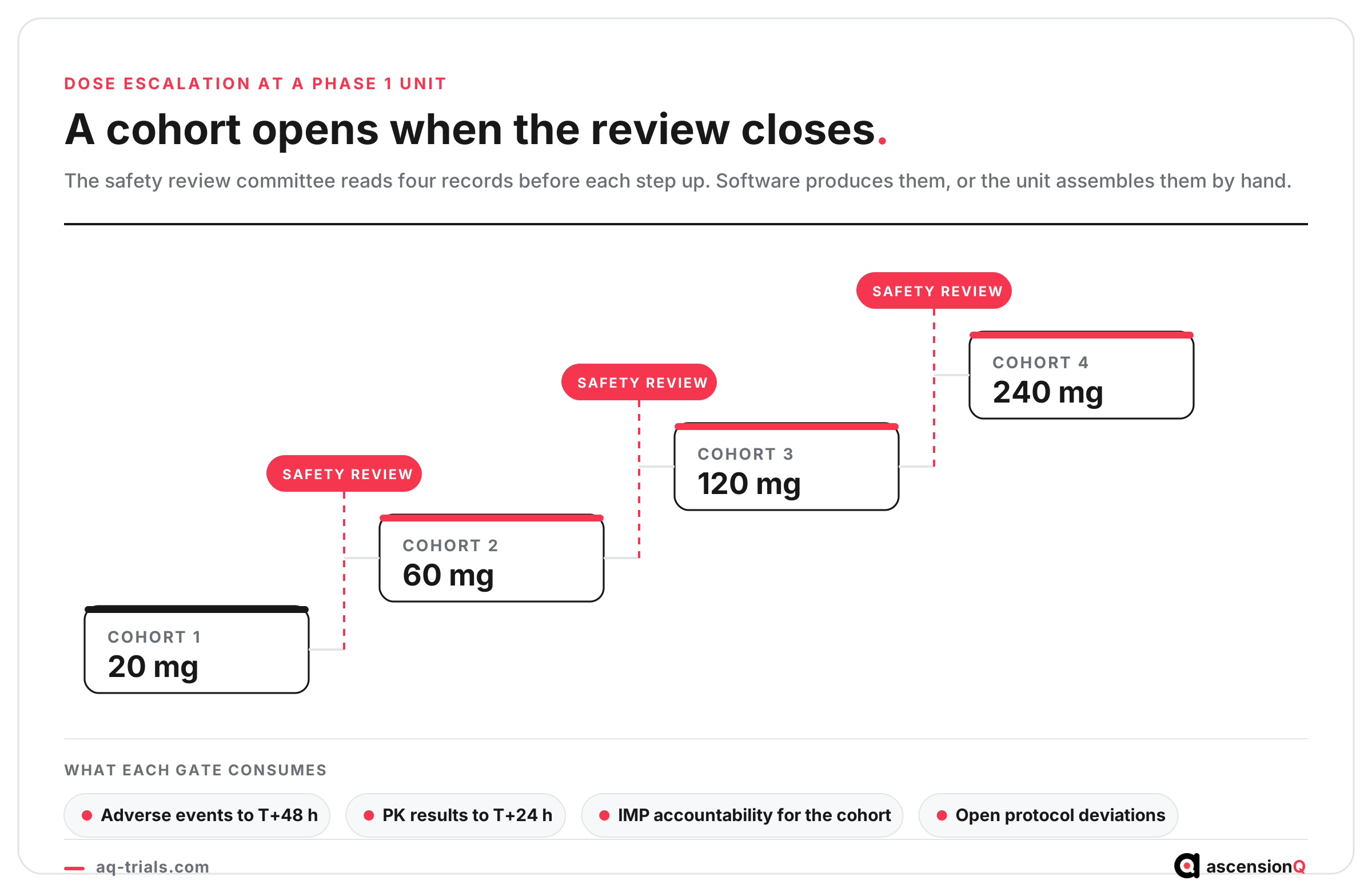
Four records carry the decision, and each one lives in a different part of a fragmented stack.
- Adverse events across the cohort to a defined timepoint. The committee reads them by cohort and dose level, so the grouping has to exist in the source record rather than in a report built afterwards.
- Pharmacokinetic results to a defined timepoint. Results arrive from a laboratory, and the unit shows which aliquot produced which result and when.
- IMP accountability for the cohort. Every unit dispensed reconciles against those received, returned or destroyed before the next dose level opens.
- Open protocol deviations. An open deviation is a question the committee asks, and an answer that takes two days to find delays the cohort.
Which Kind of Phase 1 Unit Are You Buying For?
Three kinds of organisation run early phase research in the UK, and the same product suits one while the others assemble records by hand. The accredited list carries all three.
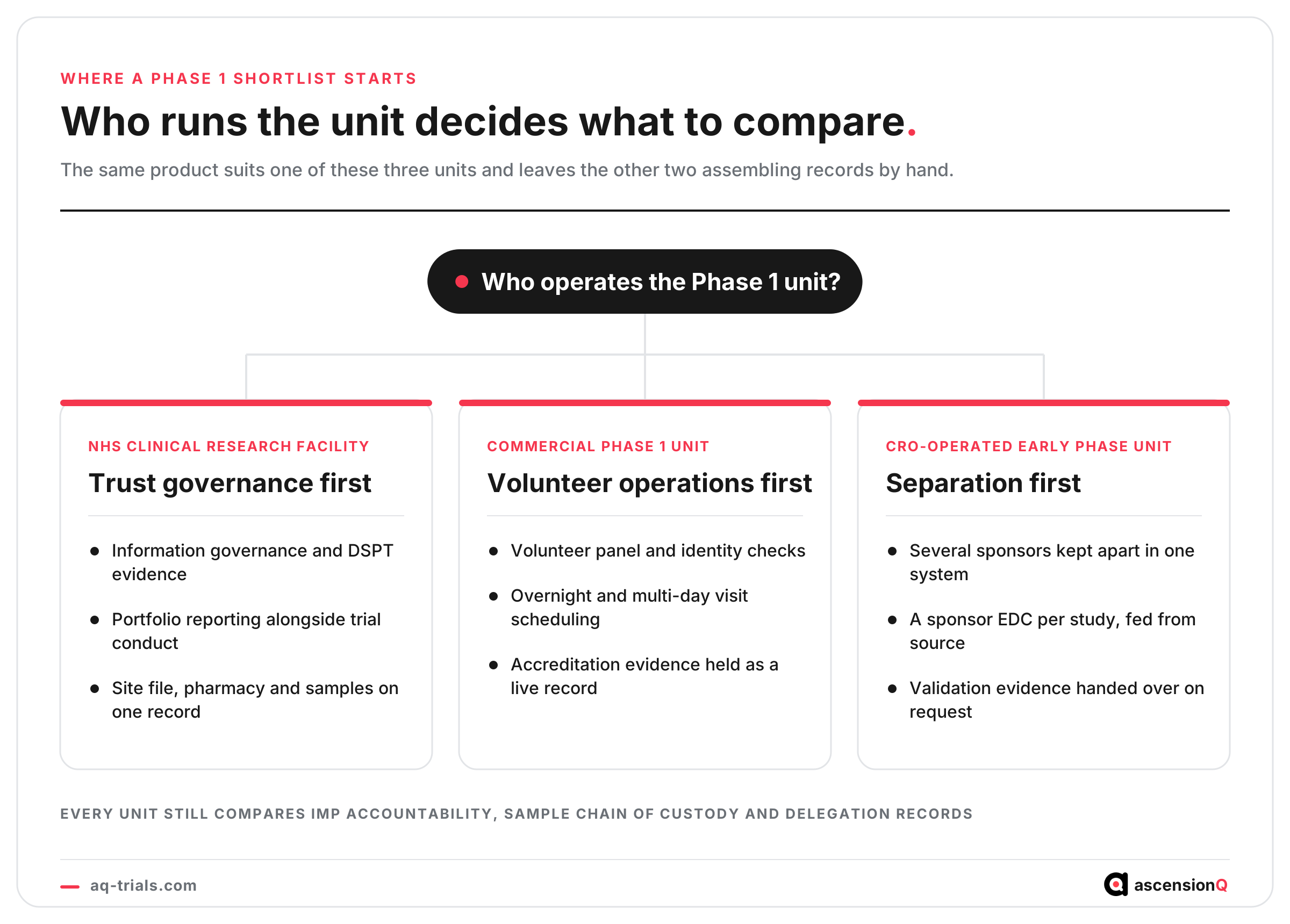
- An NHS clinical research facility answers to trust information governance first, and reports portfolio delivery alongside trial conduct. A supplier’s DSPT and Cyber Essentials position decides the shortlist earlier than any feature does.
- A commercial Phase 1 unit lives on volunteer throughput. Panel management, identity checks, residential scheduling and accreditation evidence held as a live record carry more weight than sponsor-facing data capture.
- A CRO-operated early phase unit runs several sponsors at once and keeps their records apart inside one controlled system, while feeding a different sponsor EDC per study from its own source.
All three compare the same three records: IMP accountability, sample chain of custody and delegation. The order differs.
What Should a Phase 1 Unit Ask to See in a Demonstration?
A feature list answers none of the questions above. Six requests put to a live system settle most of them, each with a visible pass or fail.
| Ask to see | What a pass looks like | What it tells you |
| A pharmacokinetic sample recorded late against its nominal time | Nominal time, actual time and the deviation stored as separate values, with the reason captured at entry | Whether the product understands a dosing day or treats it as a visit |
| A cohort safety pack assembled from live data | Adverse events, deviations and accountability for one cohort, on screen without an export | How long the gap between cohorts will be |
| One volunteer’s sample traced from draw to shipment | Aliquot identifiers, processing times, freezer location and every handover on one chain | Whether sample handling is a governed record or a spreadsheet |
| A staff member removed from the delegation log mid-study | Authorisation ends on a date, and the record of what they did before it stays intact | Whether delegation drives access or only describes it |
| IMP reconciled for a completed cohort | Received, dispensed, returned and destroyed balance, with storage conditions attached | Whether pharmacy sits on the study record or beside it |
| The validation evidence for the release you would run | Qualification documentation for the current version, supplied as standard | Your own validation effort after go-live |
The last row carries the most weight at an accredited unit. ICH E6(R3), adopted on 16 June 2026, states at Principle 9.3 that computerised systems used in clinical trials should be fit for purpose, and Annex 1 section 4.3 covers procedures, security, validation and user management. The risk-based method behind it sits in the guide to GAMP 5 and computerised system validation.
Where AQ Fits for a UK Phase 1 Unit
AQ Platform was built by Phase 1 trial doctors, which is why the unit record and the study record are the same record. AQ CTMS carries the visit and cohort structure, AQ Pharmacy holds receipt, storage, dispensing and reconciliation, and AQ Labs holds collection, processing, storage and shipment with the chain of custody attached. AQ eSource captures the source entry, so an actual time is recorded where it happens.
- Delegation drives access through AQ Digital DoA, so the authorisation record and the permission are one thing rather than two that have to agree.
- Controlled procedures and training sit in AQ QMS against the study they apply to, so an accreditation audit reads a live record rather than a rebuilt matrix.
- The investigator site file sits on the same structure, which removes the reconciliation step between the file and the study.
- The platform is UK-hosted, holds NHS DSPT Standards Met (2026) and Cyber Essentials certification, and runs ISO 27001-aligned controls.
- Each release is validated to GxP standards, covering IQ, OQ and PQ with a 21 CFR Part 11 and EU Annex 11 assessment, so validation evidence arrives with the release.
AQ Platform has been in continuous daily NHS use for six years, carries 13 sites on one connected record, and has run 70 concurrent studies across more than 150 studies. University Hospitals of Liverpool Group, Royal Free London and Liverpool School of Tropical Medicine run research on it.
AQ suits a UK Phase 1 or early phase unit that runs its own dosing days, its own pharmacy and its own samples, and wants those three on the study record the sponsor and the inspector read. Units whose only requirement is sponsor-facing data capture will find the EDC products above a closer fit.
Book a live demo and ask to see a sample recorded late against its nominal time, then a cohort safety pack built from the same record.
Frequently Asked Questions
What is the best clinical trial software for Phase 1 units in the UK?
No single product is best for every unit. The best clinical trial software for Phase 1 units in the UK is the system that records a dosing day at minute precision and holds pharmacy, samples and delegation on the same study record. ClinSpark and Medidata Rave Lite describe themselves as built for early phase data capture. AQ, Veeva SiteVault and RealTime-CTMS address unit operations.
Does a Phase 1 unit need a CTMS as well as an EDC system?
Usually yes, because the two answer different questions. The sponsor’s EDC receives reported data and is often chosen per study. The unit’s own system runs scheduling, pharmacy, samples, delegation and quality across every study it holds. A unit with only an EDC carries its operations in spreadsheets.
What does MHRA Phase I accreditation require of a unit’s systems?
The scheme is voluntary and sets requirements for the organisation rather than for a product. Version 5.0, dated 1 April 2025, calls for written procedures covering dose escalation, over-volunteering, staffing levels and routine quality assurance audits with timely corrective and preventive actions. It also treats a new electronic source data capture system as a significant change the organisation notifies.
How many MHRA accredited Phase I units are there in the UK?
Thirteen organisations appear on the MHRA’s published list, last updated on 31 July 2026. The list mixes commercial units, CRO-operated units and NHS clinical research facilities, which is why one software answer suits none of them. Accreditation is voluntary, so units outside the list also run Phase I trials.
Which Phase 1 platforms state where UK data is hosted?
Seven of the ten platforms compared here publish no hosting region on their own product pages. RealTime states regional data residency without naming a region. Only AQ states a UK hosting location. An NHS facility needs that in writing.
What should a Phase 1 unit test during a software demonstration?
Test six things on live data: a sample recorded late against its nominal time, a cohort safety pack built on screen, one volunteer’s sample traced from draw to shipment, a delegation log change mid-study, IMP reconciled for a completed cohort, and the validation evidence for the release you would run.
Also Read: Best eTMF Software for UK Trials: A 2026 Comparison