Clinical trial sample shipping is the packing, marking and handover of biological samples so they reach the laboratory at the condition the lab manual sets, on a day it can receive them, with a manifest that matches the box. A site shipping clinical trial samples has to evidence each of those steps. Most trial samples travel as UN3373 Biological Substance, Category B, in triple packaging, and frozen samples travel on dry ice, which is a dangerous good in its own right.
The failure is rarely the packaging. In the fictional study ONC-214, a site packs 24 frozen pharmacokinetic (PK) aliquots on a Thursday afternoon. The courier misses the collection, picks the box up on Friday, and the central laboratory does not receive at weekends. The box arrives on Monday with the dry ice gone. The temperature logger shows the samples above minus 60 °C for 19 hours, and the manifest lists 23 aliquots.
This guide covers classification, packaging, dry ice, ship dates, manifests, loggers and failed shipments. It forms part of our guide to clinical trial sample management.
What Does Shipping Clinical Trial Samples Involve?
A shipment is the last handling step the site controls. The lab manual sets the destination, condition and paperwork. Three shipment types cover most studies.
| Shipment type | Typical contents (the lab manual decides) | Refrigerant | What the site evidences |
| Ambient, same day | Whole blood for flow cytometry, some safety samples | None, or an ambient gel pack | Collection time, courier handover time and the stability limit |
| Frozen | PK plasma, biomarker serum and plasma aliquots | Dry ice (UN1845) | Freezer removal time, dry ice quantity, handover time and any logger record |
| Cryogenic | Viable cells such as peripheral blood mononuclear cells (PBMCs) | Liquid nitrogen dry shipper | Shipper charge record, handover time and the shipper’s temperature record |
Every row ends in a laboratory receipt that has to match what the site sent. The steps before shipment, from collection to the freezer, are covered in our guide to clinical trial sample storage.
What Is UN3373 Biological Substance, Category B?
UN3373 Biological Substance, Category B is the transport classification for infectious substances that do not meet the criteria for Category A. Human samples from trial participants usually fall here or into the exempt category. The IATA Dangerous Goods Regulations govern air transport, and the World Health Organization’s guidance on the transport of infectious substances explains the classification in plain terms. Road transport in Great Britain follows the carriage of dangerous goods rules summarised on gov.uk.
- Category A (UN2814 or UN2900): substances capable of causing permanent disability or life-threatening disease on exposure. Routine trial samples rarely fall here.
- Category B (UN3373): infectious substances outside Category A, which covers most diagnostic and research samples from participants.
- Exempt human specimen: samples with a minimal likelihood of containing pathogens, based on professional judgement. These still travel in triple packaging, marked “Exempt human specimen”.
The sponsor sets the classification in the lab manual. The site applies it and keeps the current packing instructions on file.
How Does P650 Triple Packaging Work?
Packing Instruction 650 (P650) sets the triple packaging for UN3373. Each layer has one job, and the layers together keep a leak inside the box.
- Primary receptacle. The leakproof tube or cryovial that holds the sample, with its study label.
- Absorbent material. Enough to absorb the full liquid contents of every primary receptacle, placed between the primary and the secondary packaging.
- Secondary packaging. A leakproof bag or canister around the primary receptacles. For air transport of liquids, the primary or the secondary packaging must withstand a 95 kPa pressure differential.
- Rigid outer packaging. A box strong enough for the journey, with one surface at least 100 mm by 100 mm, which carries the marks and labels.
- Itemised list of contents. Placed between the secondary and the outer packaging, which lets the laboratory check the box without opening the secondary layer.
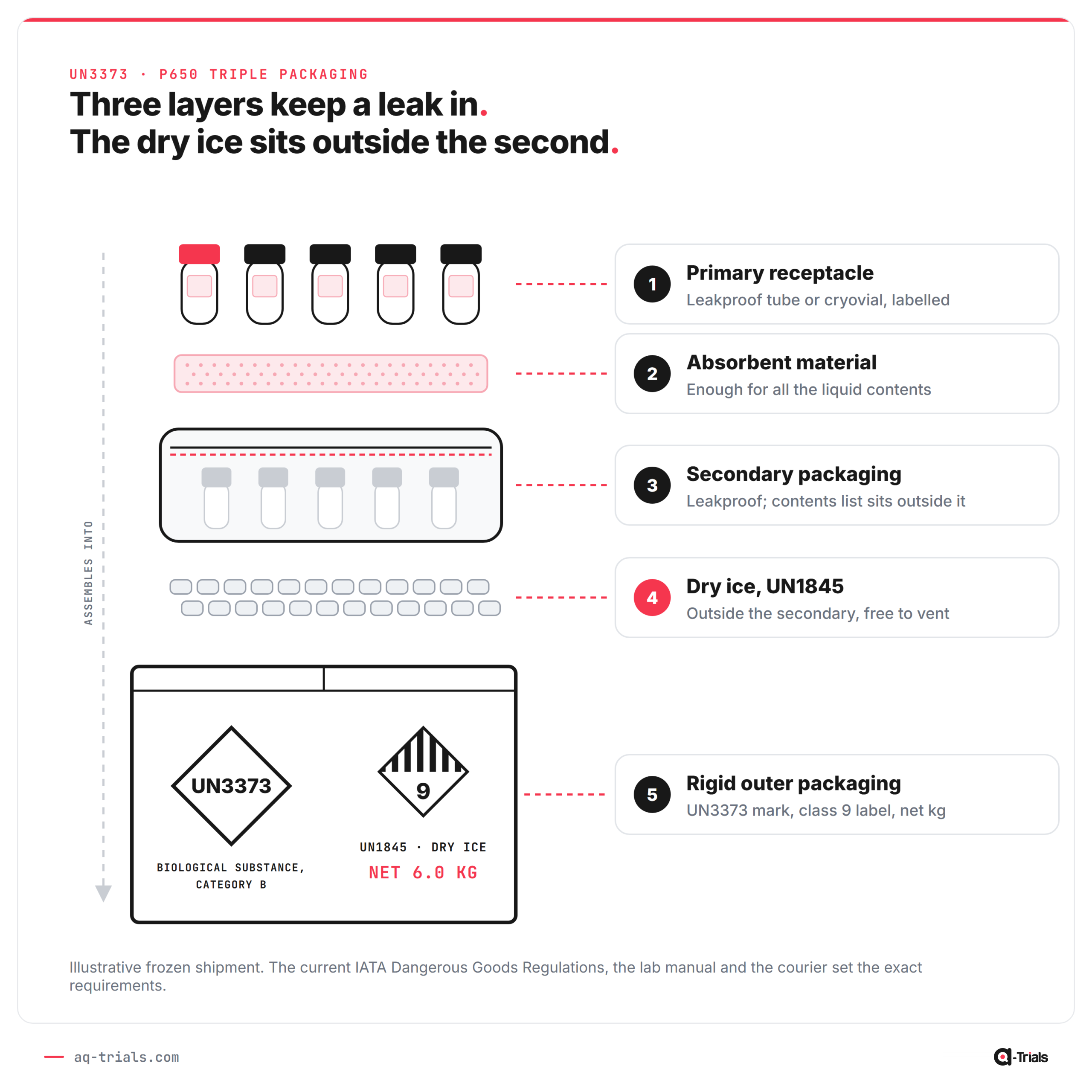
The outer box carries the marks the courier checks on sight. The current regulations and the courier’s conditions set the exact detail.
| Mark on the outer box | What it shows |
| UN3373 diamond | A square set at 45 degrees with “UN3373” inside, at least 50 mm along each side |
| Proper shipping name | “Biological Substance, Category B”, next to the diamond |
| Responsible person | Name and telephone number of a person who knows the shipment, on the package or the air waybill as the courier requires |
| Dry ice marks (frozen shipments) | UN1845, “Dry ice”, the net quantity in kilograms and the class 9 hazard label |
How Should Dry Ice Be Packed and Marked?
Dry ice is solid carbon dioxide at about minus 78 °C. It is classed as UN1845, class 9, because it turns to gas as it warms. The gas displaces air in a closed space and builds pressure in a sealed container, so the packaging rules focus on venting and quantity.
- Placement: dry ice sits outside the secondary packaging, inside the insulated outer box, which keeps the leakproof layer intact as the ice sublimes.
- Venting: the outer packaging lets the gas escape, which prevents the box from building pressure.
- Quantity: enough dry ice for the planned transit time plus a margin for delay, as the lab manual or courier specifies, which protects the samples through a missed connection.
- Marking: UN1845, “Dry ice”, the net weight in kilograms and the class 9 label on the outer box, with matching details on the air waybill for air transport.
Staff who pack and mark these shipments need training for the task, recorded in their training file and in line with the courier’s requirements. The packing task sits on the delegation log in the same way as processing. See delegation of authority in clinical research for how tasks are delegated.
The dry ice weight on the label is a record. It shows how long the box was built to last.
How Do Laboratory Receiving Days Shape the Ship Date?
A frozen box has a fixed life, and the laboratory has fixed receiving days. The ship date comes from both. Five checks decide whether a box should leave today.
| Check | Question the site answers | Typical source |
| Receiving day | Will the laboratory be open to receive on the expected arrival day? | Lab manual and the laboratory’s holiday calendar |
| Transit time | Does the courier’s quoted transit fit within the dry ice life of the box? | Courier booking confirmation |
| Collection cut-off | Is the booking confirmed for a collection time the site can meet? | Courier portal or booking email |
| Sample stability | Will each sample still be inside its stability limit on arrival? | Lab manual stability table |
| Shipment contents | Are all samples for this laboratory and this storage condition only? | Manifest against the freezer record |
Many sites avoid frozen shipments late in the week and plan around bank holidays. Dry ice orders and shipper boxes belong in the same plan as the kits. See lab kit management in clinical trials.
What Should a Shipment Manifest Record?
A shipment manifest is the list of every sample in one box, sent with the shipment and kept by the site. The laboratory checks the box against it on receipt, and any difference becomes a query. A complete manifest holds six elements.
- Study and site: protocol number, site number and the sending contact.
- Sample identifiers: the label or accession number on each tube, with sample type and aliquot number.
- Participant and timepoint: participant number, visit and nominal time for each sample.
- Condition: ambient, refrigerated, frozen or cryogenic, with the refrigerant.
- Counts and courier: total samples, waybill number and handover time.
- Packed by: the delegated person who packed the box, with the date.
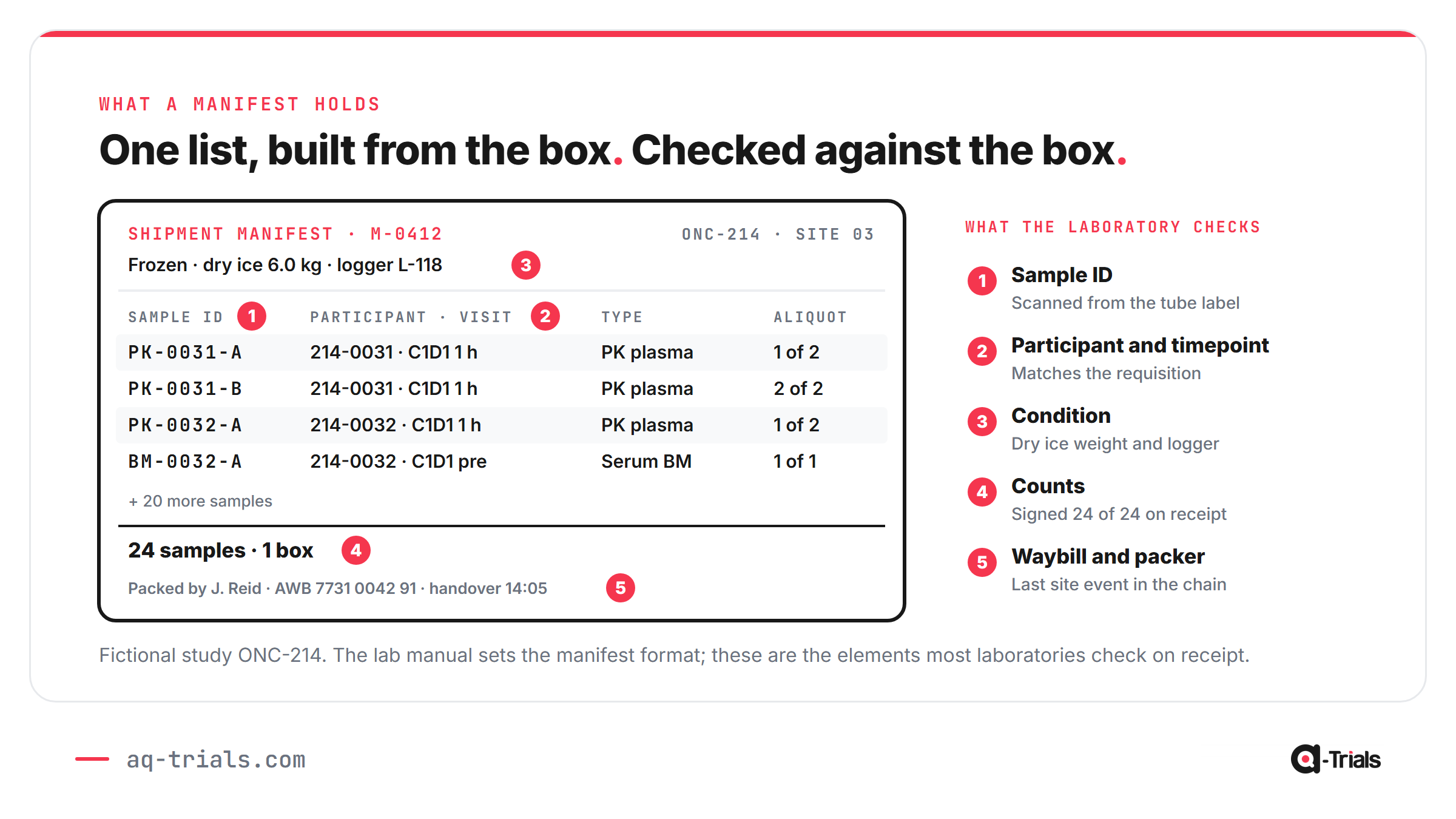
The manifest also closes the site’s chain of custody. The courier handover time is the last event the site records for each sample, as our guide to clinical trial sample tracking explains. A copy of each manifest belongs in the investigator site file.
Manifests Typed at the Bench Compared With Manifests Built From Scanned Samples
The central difference is where the list comes from. A typed manifest is a second record written from the first. A manifest built by scanning each tube into the box is the record of what went into the box.
| Aspect | Manifest typed at the bench | Manifest built from scanned samples |
| Source of the list | Copied from the freezer map or a worksheet | Each tube scanned as it goes into the box |
| Wrong sample in the box | Found by the laboratory on receipt | Refused at packing if it is for another laboratory or condition |
| Counts | Added up by hand | Taken from the scans |
| Freezer record | Positions crossed off later | Samples removed from storage as they are packed |
| Filing | Printed, signed and filed when time allows | Linked to the site file at courier handover |
What Do Temperature Loggers Add to a Shipment?
Some studies send a temperature logger in each frozen box, and the laboratory downloads it on receipt. It answers one question the manifest cannot: did the samples stay at their condition for the whole journey?
- The logger start time is recorded at packing, which ties the record to the box and the manifest.
- The logger identifier is written on the manifest, which lets the laboratory match the download to the shipment.
- The site files the logger report with the manifest, which keeps the transport evidence with the shipment it describes.
What Should a Site Do When a Shipment Is Delayed or Arrives Compromised?
A delay happens on the road, and the site can still act. A compromised arrival is reported by the laboratory, and the site supplies the facts and records the decision. The site’s standard operating procedure (SOP) sets the detail.
- Track the box. Check the courier status against the expected arrival, and contact the courier as soon as the box misses a scan.
- Ask for dry ice replenishment where the courier offers it, and record the request and the outcome.
- Tell the laboratory and the sponsor, with the waybill number, the manifest and the expected new arrival time.
- Collect the receipt report from the laboratory: condition on arrival, dry ice remaining, logger data and any difference from the manifest.
- Record the sponsor’s decision for each sample: analyse, analyse with an annotation, or reject.
- Assess the event under the site’s deviation process, and open a corrective and preventive action (CAPA) where the cause could recur.
| Receipt finding | Likely cause | What the site records |
| Samples thawed or partly thawed | Transit delay, too little dry ice, receiving day missed | Packing time, dry ice weight, courier timeline and the sponsor’s decision per sample |
| Broken or leaking tube | Overfilled tube, cap not seated, no interior support | Affected identifiers and whether the secondary packaging held the leak |
| Sample on the manifest, absent from the box | Left in the freezer, packed into another shipment | Search result from storage and other shipments, then the outcome |
Repeat findings on the same route or the same day of the week point to a system cause. The fix belongs in the quality system. See managing deviations in clinical research and a CAPA example walked through step by step. Each receipt finding also becomes a line in the study’s sample reconciliation.
Also Read: Receipt and Quarantine: Why Every Delivery Is Locked Until Someone Releases It
What Do Monitors and Inspectors Check About Sample Shipments?
Monitors trace shipments in both directions, from laboratory result back to box and from manifest forward to receipt. Five questions come up repeatedly.
- Is there a manifest on file for every shipment, with a matching laboratory receipt?
- Was each frozen sample within its stability limit between freezer removal and arrival?
- Were the people who packed shipments delegated and trained for the task?
- Were delayed or compromised shipments reported, and is the sponsor’s decision recorded for each sample?
- Are temperature logger reports filed with the shipments they describe?
ICH E6(R3) expects trial records that are attributable, complete and retrievable, and the MHRA sets out its approach in its good clinical practice inspection guidance. Shipment records are part of that evidence, alongside the laboratory certificates listed in the ISF essential documents checklist.
Also Read: MHRA GCP Inspection Common Findings
How Does AQ Labs Support Shipping Clinical Trial Samples?
AQ Labs is the lab sample management module of AQ Platform. It records each shipment as part of every sample’s own history, on the same record as the site file.
- Shipments are built by scan, and only samples for the receiving laboratory and storage condition are accepted, which keeps the wrong sample out of the box.
- Ship-day and stability checks run before packing, which flags a box that would arrive on a day the laboratory cannot receive it.
- The packing checklist reflects the specimen classification, such as UN3373 for Category B biological substances, and the refrigerant, such as dry ice, which puts the right marks on every box.
- The manifest is linked to the site file at courier handover, which gives the site and the laboratory the same list.
- Only staff delegated and trained on the current lab manual can handle samples, which applies to packing as it does to processing.
AQ Labs works alongside couriers and central-laboratory portals, and it is priced and deployed as its own module. Book a live demo to see a frozen shipment built by scan, from freezer to manifest.
Frequently Asked Questions
What is UN3373?
UN3373 is the UN number for Biological Substance, Category B: infectious substances that do not meet the criteria for Category A. Most clinical trial samples travel under UN3373 or as exempt human specimens, in triple packaging.
How is dry ice marked on a sample shipment?
The outer box shows UN1845, the words “Dry ice”, the net quantity of dry ice in kilograms and the class 9 hazard label. Air shipments also carry the dry ice details on the air waybill. The packaging must let the carbon dioxide gas escape.
What goes on a clinical trial sample shipment manifest?
A manifest lists the study and site, each sample identifier, participant and timepoint, sample type and aliquot, storage condition, total counts, the courier waybill number and the person who packed the box. The laboratory checks the box against it on receipt.
Who decides whether samples from a delayed shipment can be used?
The sponsor decides, usually with the central laboratory, using the receipt condition, the logger data and the stability data for each analyte. The site supplies the packing and courier facts and records the decision for each sample.