Veeva SiteVault eSource Alternatives for NHS and Academic Sites
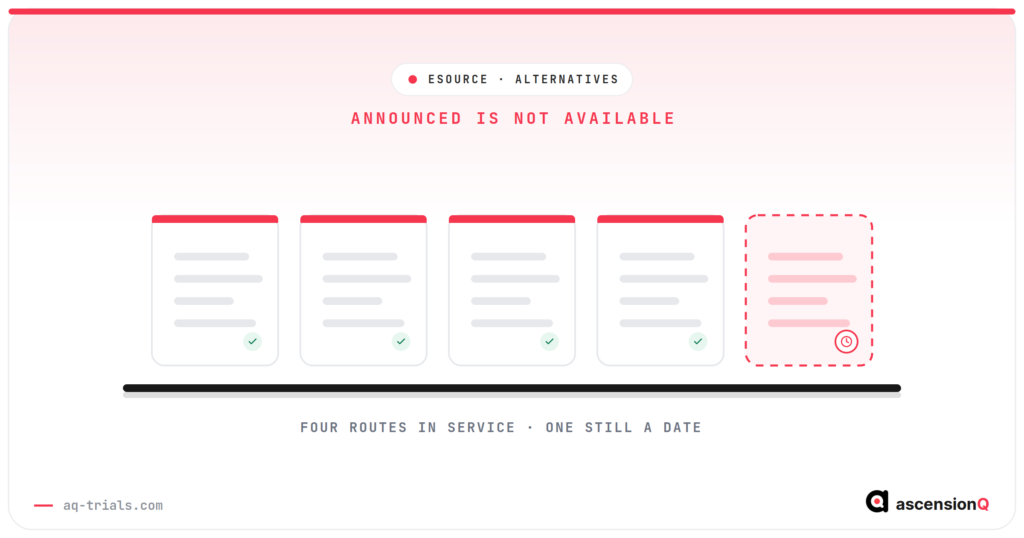
Veeva SiteVault eSource alternatives for NHS and academic sites shown as a shelf of five eSource routes, four in service and one dashed slot still awaiting release

Veeva SiteVault eSource alternatives for NHS and academic sites fall into four groups: a site eSource platform the site licenses, a sponsor-issued system, the hospital EPR used as source, and the site’s own forms. This guide covers what Veeva publishes about SiteVault eSource and which routes are open today.

eSource Software for UK Research Sites: What to Compare Before You Buy
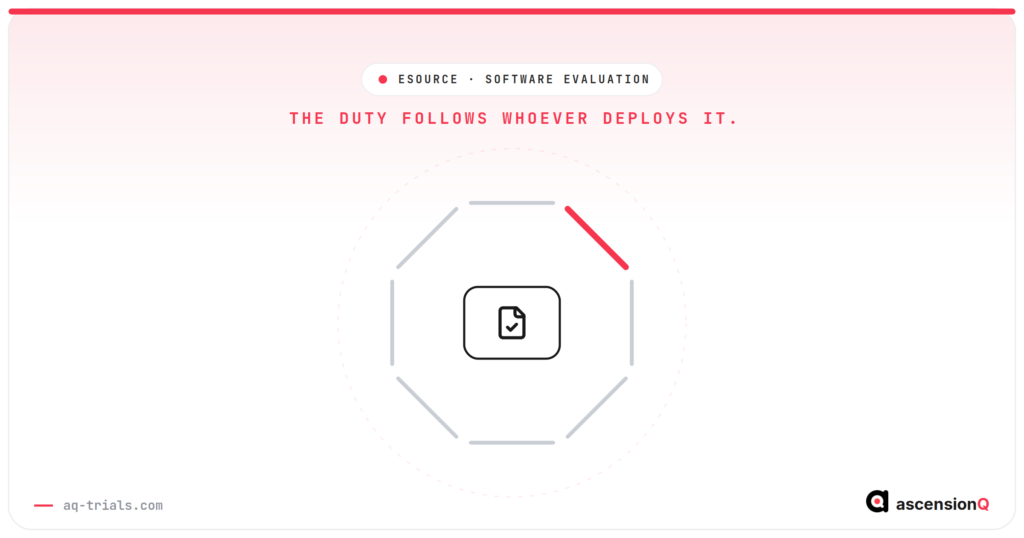
eSource software evaluation for UK research sites: eight ICH E6(R3) computerised system requirements around the record a site buys

eSource software for a UK research site is compared on six things: validation evidence, the depth of the audit trail, how access control maps to delegation, the route data takes to the sponsor’s system, the position on the hospital EPR, and the exit terms. This guide sets out the question to ask under each heading.

Tracing One Visit from Source Entry to Query Resolution
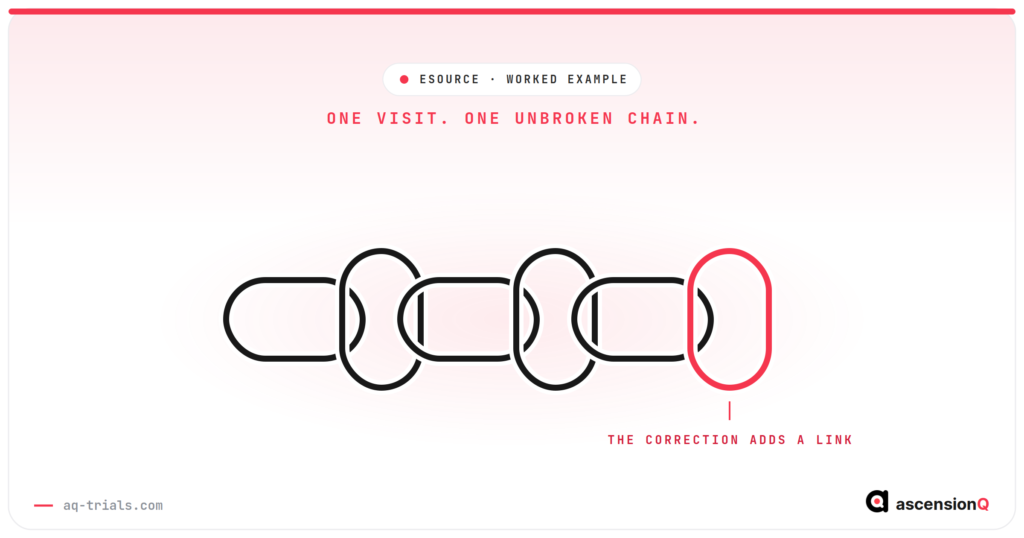
Conceptual illustration of one clinical trial visit as a single unbroken chain of six links, with the final crimson link showing that a correction adds an entry to the eSource audit trail rather than replacing one

One visit traces from source entry to query resolution through five stages, and each stage writes its own entry into the audit trail. This worked example follows one hypothetical UK site visit through booking, capture, investigator endorsement, a monitor query and filing.

How Does a Visit Schedule Become an eSource Form?
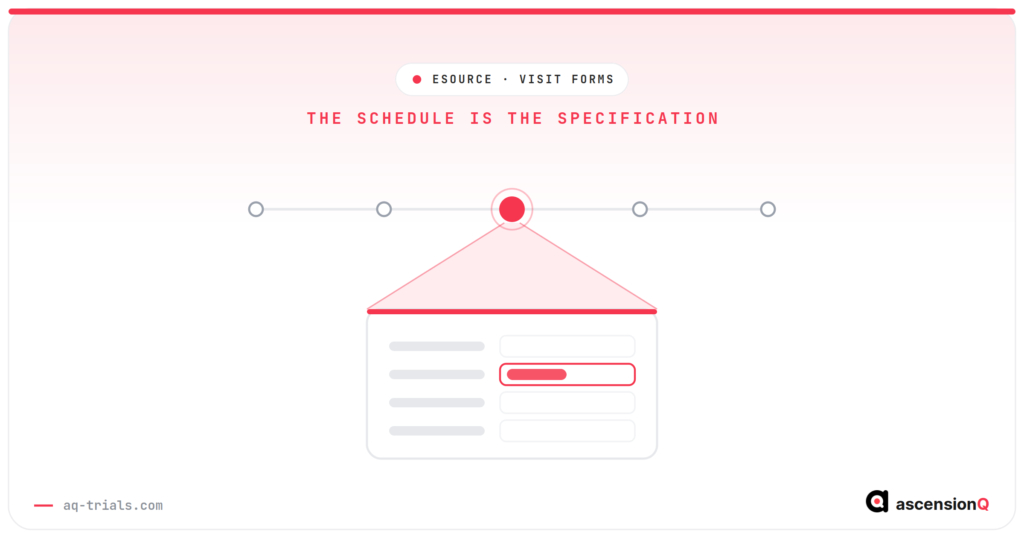
A protocol visit schedule projecting one visit into an eSource visit form, showing that the schedule of events is the specification the form is built from

A visit schedule becomes an eSource form when every row of the protocol’s schedule of events is built as a field on a validated electronic form. This guide covers the six build decisions, where the visit window lives, out-of-window visits, unscheduled visits and what an amendment changes.

EHR-to-EDC Integration vs Site eSource: Which Suits an NHS Trust?
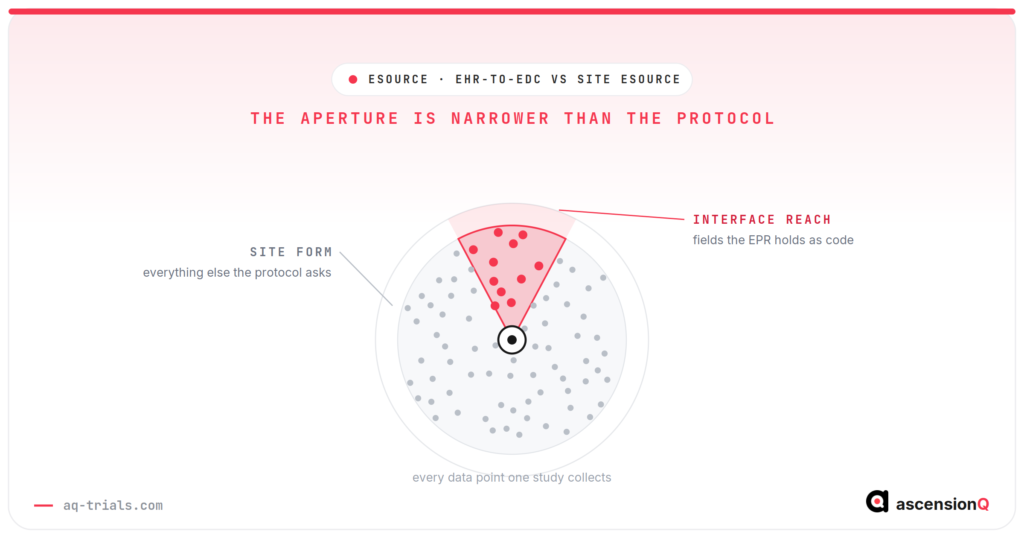
Conceptual illustration of EHR-to-EDC versus site eSource at an NHS trust, showing a narrow crimson aperture covering only part of a circle of one study's data points, with the remainder left to site forms

EHR-to-EDC integration suits an NHS trust that needs the same structured fields across many studies and has digital capacity to maintain an interface. This guide compares the two routes on data coverage, the trust approval chain, what the EPR supplier controls and where the cost falls.

UK Model Agreements for Clinical Trials: mCTA and mNCA
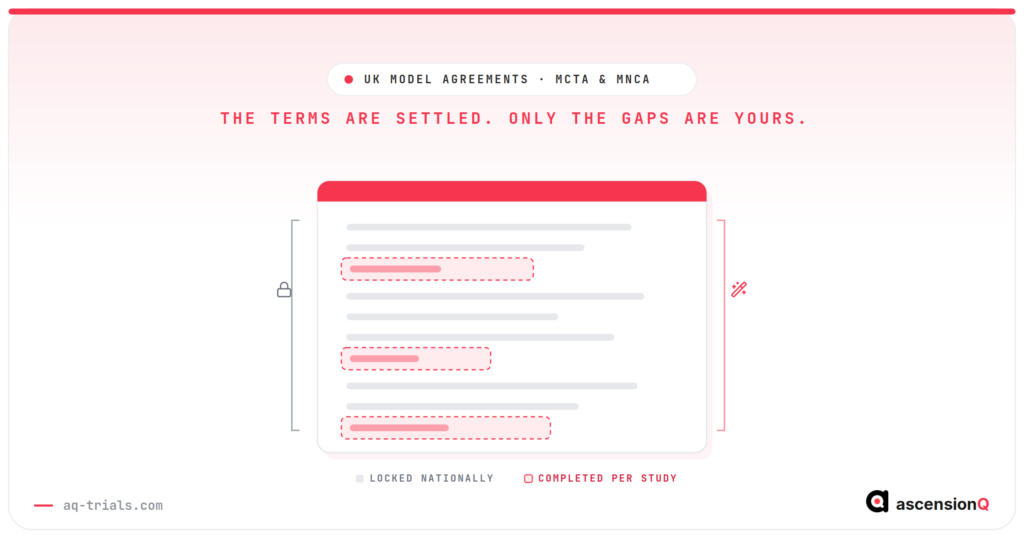
UK model clinical trial agreement shown as a settled document with three open fields, locked nationally and completed per study

A UK model clinical trial agreement is a standard-form contract published nationally so the terms are settled before a study reaches a site. This guide covers the mCTA and mNCA, the full template suite, who signs, the appendices and schedules, unmodified use in each nation, and what April 2026 changed.

Which Studies Are Excluded From UK Trial Set-Up KPIs?
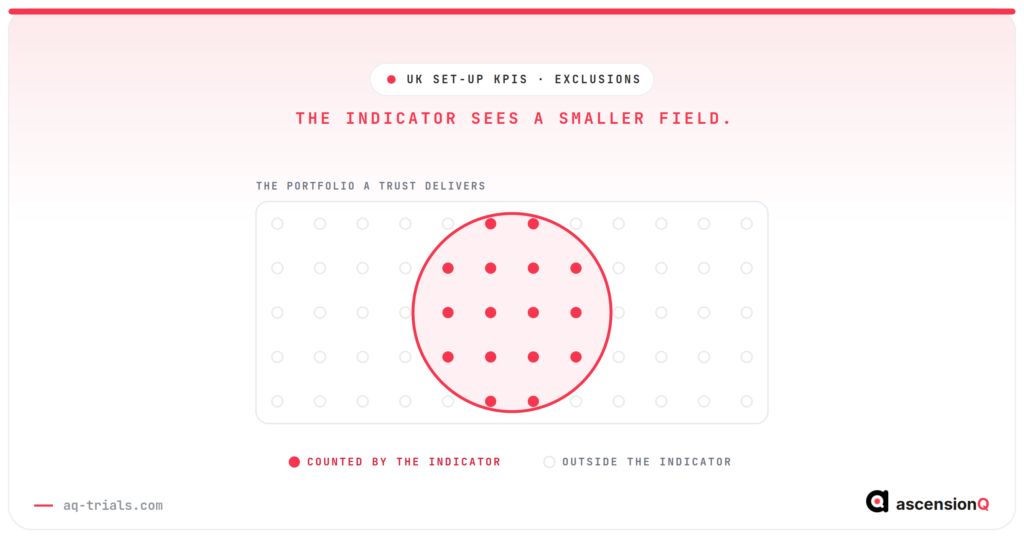
Conceptual illustration of clinical trial KPI exclusions showing a field of studies delivered by an NHS trust with a measurement aperture over a small subset counted by the indicator

The UK clinical research delivery KPIs exclude studies on four grounds: study type, completion of the measured step, the state of the recorded dates, and portfolio membership. This guide covers what each of the seven indicators leaves out, which time the clocks remove, and which research never enters the measurement at all.
Hitting the 150-Day Study Set-Up Target: An NHS R&D Playbook

Conceptual illustration of the 150 day study set-up target as a finish line, with one site marker across it while the rest of the sites are still in set-up behind it

The 150-day study set-up target runs from regulatory application to a first participant, and the national indicator now reports 100%. This guide covers what the clock measures and excludes, why the two local segments sit at 56% and 61%, what national reform has already settled, and what an NHS R&D office should run differently.

What Is a SoECAT? Schedule of Events Cost Attribution Tool

A study schedule of activities passing through an AcoRD attribution point and splitting into four payers: research, support, treatment and excess treatment cost

A SoECAT is the UK document that maps every activity in a non-commercial clinical study to the party that pays for it, under the DHSC AcoRD framework. This guide covers what SoECAT stands for, the five cost categories, how the tool is structured, who authorises it, the 20 working day lead time, its role at grant, HRA and site set-up, and its link to Excess Treatment Costs.

A SoECAT, or Schedule of Events Cost Attribution Tool, is the UK document that maps every activity in a non-commercial clinical study to the party that will pay for it. It records each research activity once, marks the visit column in which it happens, and assigns one of five cost categories to it. An AcoRD Specialist in the lead Regional Research Delivery Network authorises the completed form. That authorised form then travels with the funding application, the IRAS submission and the UK Local Information Pack for every participating NHS site.

A SoECAT does two jobs at once. It tells a grant funder how much of the study is theirs to pay for. It tells the NHS how much service support cost and how much excess treatment cost a participating trust can recover for hosting the study. Without an authorised SoECAT the study has no route to either of those payments. That is why an incomplete or late SoECAT is not a paperwork problem: it is a set-up problem that reaches the site as unfunded activity.

A study schedule of activities passing through an AcoRD attribution point and splitting into four payers: research, support, treatment and excess treatment cost

What Does SoECAT Stand For?

SoECAT is the acronym for the Schedule of Events Cost Attribution Tool. The tool is also referred to as the Schedule of Events Cost Attribution Template. It is a national tool, published for use across the four UK nations by the NIHR Research Delivery Network Coordinating Centre, and it operates under the Department of Health and Social Care Attributing the costs of health and social care Research and Development guidance, known as AcoRD.

The name matters because it explains what the tool does and what it is not. It is a schedule of events, so it lists the study activities and when they happen. It is a cost attribution tool, so it assigns each of those activities to a payer, not a budget line. It replaces the older Excel workbook with an online version inside the NIHR Central Portfolio Management System (CPMS), which became the required version for new applications from April 2023.

Who Needs a SoECAT?

A SoECAT is required for a study that meets all of the following: the study is non-commercial or investigator-led commercial-collaborative, the study is intended for the NIHR Research Delivery Network portfolio, the study needs Health Research Authority approval, and the study will use NHS resources. Where a study meets those tests the SoECAT is the document that captures its costs.

Commercial contract research does not use a SoECAT. Under National Contract Value Review, commercially sponsored studies use the Interactive Costing Tool (iCT), which the sponsor pays into for every participating NHS site. The DHSC AcoRD guidance draws this line explicitly: “the funding arrangements for commercial contract research studies are straightforward. The NHS is required to recover, from industry, all costs over and above the standard NHS treatment cost.”

The consequences of not completing a SoECAT when one is required are stated in the tool itself. The Study Information tab carries a declaration that if a SoECAT is not completed the study is “not eligible to have its NHS Support Costs or Excess Treatment Costs recompensed.” An NIHR West Midlands network note puts it plainly: “a SoECAT is the only way to confirm ETCs (no SoECAT equates to no ETCs).”

  • Included: non-commercial studies applying for grant funding that will use NHS resources and need HRA approval.

  • Included: investigator-led commercial-collaborative studies intended for the RDN portfolio.

  • Included: studies with an outline stage that has passed to full or stage-two application. A SoECAT is not required at outline stage.

  • Excluded: commercial contract research, which uses the iCT under NCVR.

The AcoRD Framework: How Costs Are Attributed

The SoECAT does not decide who pays. AcoRD decides who pays, and the SoECAT captures the decision. AcoRD is the Department of Health and Social Care’s guidance for England on attributing research costs. The devolved nations run their own versions: AcoRD Scotland, AcoRD Wales, and an equivalent published by the Northern Ireland HSC R&D Division. The principles are consistent across the four nations. The route to reimbursement is nation-specific.

Attribution follows the primary purpose of the activity. The guidance sets a two-step test that the SoECAT applies to every row. The first question is whether the activity is a service provided by, or on behalf of, the NHS that treats or contributes to the care needs of a patient. The second question is whether that cost would carry on being incurred if the study stopped and the patient care service continued.

AcoRD two-question attribution test deciding whether an activity is a research cost, service support cost, treatment cost or excess treatment cost

Cost categoryWhat it coversWho pays
Research Cost (Part A)Activities undertaken to answer the research question. They end when the research ends. Examples include randomisation, screening tests after patient approach, trial coordination, data analysis and results publication.Funded in full by all grant funders.
Research Cost (Part B)Research activities where the funder can, in one case, treat the cost as part of NHS infrastructure. Examples include local trial coordination and investigator time understanding the research.The grant funder, unless the funder is an Association of Medical Research Charities member and the activity is undertaken by existing staff, in which case the NHS meets the cost.
Service Support CostPatient care activities linked to safety or duty of care during the study, which end when the study ends even if standard care continues. Examples include additional monitoring, consent, extra visits and study-specific tests.The NHS, through the Research Delivery Network.
Treatment CostPatient care that would continue if the study stopped and the patient care service continued. This is normal care.The NHS, through normal commissioning.
Excess Treatment CostThe difference between the study treatment cost and the standard treatment cost, where the study treatment is more expensive. Derived by comparing the Per-Participant Activities against the Standard of Care baseline in the tool.The NHS, via the ETC route managed by the RDN and DHSC.

Also Read: What Is NCVR? National Contract Value Review Explained.

What Is Inside a SoECAT?

The SoECAT is a schedule of activities across a set of worksheet tabs, each with a specific job. The online SoECAT keeps the same logical structure as the retired Excel version, published on the record by NIHR local networks and NHS research offices that still host the workbook. The core discipline in the tool is that every activity is logged once on the List of Activities, then referenced from the Standard of Care and Per-Participant Activities tabs by marking the visit column in which it happens.

  • Study Information records the IRAS reference number, funder, chief investigator, planned start and end, number of sites and the lead network. It also records the AcoRD Specialist authorisation.

  • Standard of Care sets the baseline of what the NHS would do for the patient outside the study. Activities in this tab are marked with an “x” only. They carry no cost attribution because they are the yardstick against which excess treatment cost is calculated.

  • General Activities records set-up, on-trial, close to recruitment and site close-out activities that are not per-participant.

  • Per-Participant Activities is where the study is costed one arm at a time, up to fifteen arms. Each row is one activity in one visit, with its cost category attribution.

  • Summary outputs the per-participant and site-level totals, split by Research Cost, NHS Service Support Cost and NHS Excess Treatment Cost, alongside the proposed per-patient ETC.

An activity row is a small piece of structured data with a specific job. The row records the area of activity (either an investigation such as an MRI, or a procedure costed at staff time), the specific activity, its duration in minutes, who performs it (medical, nursing or administrative grade), and then the visit column in which the activity happens with the attribution letter for that cell.

Anatomy of a SoECAT: workbook tabs, one activity row with duration and staff, and the five attribution values from research Part A to excess treatment cost

Who Completes and Authorises the SoECAT?

The chief investigator holds accountability for the SoECAT. The costing itself is usually completed by a designated Study Representative, working with the intended sponsor. Sponsor involvement is not optional: the RBHH research office SoECAT guidance is explicit that “Researchers must not complete the template without support from their intended Sponsor.” Sponsor confirmation of accuracy is a prerequisite before authorisation can be requested.

Authorisation itself sits with the AcoRD Specialist in the lead Regional Research Delivery Network. The RRDN is the successor to the Local Clinical Research Network under the NIHR Research Delivery Network, which launched on 1 October 2024 with twelve RRDNs and a central Coordinating Centre. In Northern Ireland the authorising body is the HSC R&D Approvals Service. In some English trusts the AcoRD Specialist role has been devolved to the trust’s own research office. In every case the authorising decision is not the sponsor’s or the funder’s: it is the specialist’s, against the AcoRD guidance.

  • Chief investigator: accountable for the schedule of study activities and the patient journey the SoECAT describes.

  • Study Representative: completes the costing rows and requests validation. Once validation is requested the form is frozen. No further changes can be made until the review closes.

  • Sponsor: confirms accuracy of the attributions before validation is requested. Sponsor sign-off is a precondition to authorisation.

  • AcoRD Specialist: authorises the SoECAT against DHSC AcoRD. Review outcomes are validated for grant application, validated for HRA, request for changes, or not validated.

When Is the SoECAT Required, and by When?

The SoECAT appears at three fixed points in the set-up sequence. First, the authorised SoECAT is required to accompany the funding application to the grant funder. Second, the authorised SoECAT is included in the IRAS document set for the HRA application. Third, the SoECAT forms part of the UK Local Information Pack shared with each participating NHS organisation for capacity and capability confirmation. That third use is what makes the SoECAT operationally important at site level, not only at funding level.

The DHSC ETC guidance sets the lead time. The absolute minimum is 20 working days before submission of the funding application, and the guidance recommends up to 10 additional working days of leeway to accommodate amendments and escalations. Regional networks publish their own minimums, from 10 working days in West Midlands and Yorkshire and Humber, through to 20 working days in Kent, Surrey and Sussex, and Eastern. The Kent, Surrey and Sussex network states that it “maintains the right to refuse to meet application deadlines” if given less than 20 working days.

SoECAT authorisation lead time running backwards from the funding deadline, showing a 20 working day minimum for AcoRD specialist review plus leeway

The freeze on the SoECAT during validation matters at set-up, not just at grant stage. A team that submits an authorised SoECAT to the HRA and then wants to change a visit schedule or add an activity has to re-open, re-cost and re-authorise the tool. Every one of those re-cuts brings the review clock back into play. A team that treats the SoECAT as the last thing to nail down before an application deadline is the team most likely to hit the ETC route with an outdated form.

What Is the Funder Export?

The Funder Export is the output document that the online SoECAT generates for the funder. It is the artefact that goes into the funding application. The UKRI/MRC application guidance states that the applicant should “accompany your application with the ‘study information’ and ‘summary’ page of the ‘funder export’.” The Excel SoECAT was withdrawn for new applications after 31 March 2023 and the Funder Export is the online tool’s replacement for it.

The practical implication is that the Funder Export locks a version of the SoECAT to a point in time. If the schedule of activities changes after the export is generated, the funder is looking at the old version until the SoECAT is re-authorised and a new export produced. That is why the SoECAT is treated as a live document across set-up rather than a one-off application artefact.

How Does the SoECAT Relate to the Schedule of Events?

The Schedule of Events (SoE) is a different, older, HRA-issued document. It records the schedule of study activities for the local information pack without attributing them to payers. The HRA’s current guidance pairs the Organisation Information Document with a Schedule of Events for non-commercial studies. The SoECAT is an accepted substitute for the SoE where the study has sought grant funding.

AspectSchedule of Events (SoE)SoECAT
OwnerHRA.NIHR RDN Coordinating Centre.
AttributionNone. Activities are listed without cost categorisation.Every activity carries one of five attribution values.
When usedAny non-commercial study submission where grant funding has not been sought.Any non-commercial or investigator-led commercial-collaborative study seeking grant funding for use of NHS resources.
Reimbursement routeNone. The SoE does not open a route to service support cost or ETC.Authorised SoECAT is the route to NHS Support Costs and Excess Treatment Costs.
Authorising bodySponsor.AcoRD Specialist in the lead RRDN.

The Statement of Activities is a separate historical artefact and is not the SoECAT. The HRA re-branded the Statement of Activities as the Organisation Information Document (OID) on 5 June 2019. The OID and the SoE or SoECAT operate together at site level: the OID describes what the sponsor is asking the participating organisation to do, and the SoE or SoECAT describes the schedule and, in the SoECAT’s case, the cost attribution.

Also Read: HRA Technical Assurance: Pharmacy and Radiation Reviews.

How Does the SoECAT Connect to Excess Treatment Costs?

Excess Treatment Costs are the difference in patient care cost between the study treatment and the standard treatment. The SoECAT is the artefact that calculates them, because it is the only place in the set-up sequence where the two schedules sit side by side. The Standard of Care tab describes what the NHS would have done. The Per-Participant Activities tabs describe what the study will do. The gap between the two is the ETC, and the tool reports it as a proposed per-patient ETC value.

An authorised SoECAT is a hard prerequisite for the ETC route. The gov.uk ETC guidance sets it out plainly: the authorised SoECAT must accompany the funding application, the IRAS submission, and the local information pack. The Northern Ireland HSC R&D Division states that “an authorised, current, SoECAT must be in place for a claim to be made. This is regardless of whether a SoECAT was required by the funder.” The absence of a SoECAT closes the ETC door for that study.

Two thresholds sit above the ETC route. Studies with total ETCs below £1 million and average ETCs per participant below £20,000 are handled through the standard national process. Studies that exceed either threshold trigger additional financial assurance review by DHSC before funding approval. Payments are recruitment-driven and paid bi-annually in arrears against confirmed CPMS recruitment data, which is where the SoECAT connects directly to the site data recorded in CPMS and LPMS.

Where the SoECAT Fits in UK Study Set-Up

The SoECAT sits between three separate processes that never used to touch each other cleanly: research funding, regulatory approval, and NHS site set-up. In the 2024 to 2026 reforms of UK study set-up, that hinge role has become more consequential. The UK clinical research delivery KPIs now measure how long it takes a study to move from regulatory approval to first participant at a site, and the local set-up phase is where most sites lose time. A SoECAT that is out of date at capacity and capability confirmation forces a re-cut before the site can confirm.

  • Grant application: the authorised SoECAT accompanies the funding application, ideally 30 working days before deadline.

  • IRAS submission: the authorised SoECAT is part of the IRAS document set for HRA/HCRW approval.

  • UK Local Information Pack: the SoECAT is one of the documents the sponsor shares with every participating NHS/HSC organisation for capacity and capability confirmation.

  • ETC claims post-award: the authorised SoECAT is the reference document against which recruitment-driven ETC payments flow to sites.

The failure mode is consistent across studies. A team completes the SoECAT under grant deadline pressure, receives authorisation, and never touches the form again until an inspection or a site raises a query about a cost. By then the protocol has moved on, the activities have changed, and the authorised SoECAT is misaligned with what the study actually does. The site cannot recover the right service support cost or ETC on those changed activities without a fresh authorisation. The clock resets, and the delay lands at the site.

Also Read: Why NHS Sites Miss the 90-Day Set-Up Target and How to Close It.

How AQ Platform Keeps the SoECAT Aligned Across Set-Up

A SoECAT that goes stale during set-up is a symptom of a fragmented document set. The SoECAT lives on one system, the protocol on another, the visit schedule in a third, and the participating site’s own visit workbook in a fourth. The AQ platform was designed to remove that fragmentation across the connected trial documentation modules the site works in.

  • AQ CTMS holds the schedule of study activities and the visit windows the site actually books against. When the schedule changes, the change is captured once and flagged for review.

  • AQ eTMF, built on the DIA TMF Reference Model, files the authorised SoECAT and the Funder Export as controlled documents with version currency visible to the study team.

  • AQ eISF holds the site’s live copy for inspection readiness, so the version at site matches the version at sponsor.

  • AQ CAPA tracks the corrective action when a schedule change requires a SoECAT re-cut, so the re-authorisation is treated as a controlled step, not an afterthought.

The point is not to replace the SoECAT. The SoECAT is a national tool with a national authorising route. The point is to keep the authorised version aligned with the study the site is running, so that ETC and service support cost claims flow to the site without a re-cut every time.

Book a live demo to see how AQ keeps the SoECAT, the protocol schedule and the site visit workbook aligned across UK study set-up.

Free guides · PDF
Find the right guide for you

Pick a module, your organisation type, or both — we'll match the guides and email them to you.

Most popular guides
Explore
15+ guides

Free guides · PDF

Guides matched to you.

✓ Written for first-in-human & Phase 1 sites

✓ Inspection-ready checklists & templates

✓ Aligned to MHRA, FDA & EU Annex 11