A clinical trial management system, an electronic trial master file, an electronic data capture system and an electronic investigator site file answer four different questions about the same trial. A CTMS answers what the study is doing. An eTMF answers what the sponsor has filed. An EDC system answers what the study measured. An eISF answers what the site holds. The system you actually need is the one that owns the record you cannot produce today.
Most teams reach this question from the wrong end. They compare products, shortlist vendors, and find out afterwards that two systems claim the same record and none of them owns the one an inspector asked for. The four categories overlap by design. The overlap is where studies lose control of their own evidence.
This guide covers the following:
- The question each of the four systems answers, and the record each one owns.
- Which of them UK law and ICH-GCP E6(R3) actually name, and which are market categories.
- Where each system stops, and what falls off the end of it.
- The records that end up with two owners, and what a contested record costs at inspection.
- A decision order for closing the gaps, and what a demonstration should prove before you buy.
What Does Each System Own?
Ownership is the useful test. Every record produced by a trial has one system that holds the authoritative version and one party accountable for it. The four acronyms describe four different ownership territories, and a fifth system, the electronic pharmacy site file, owns the investigational product record at sites that hold stock.
| System | The question it answers | The record it owns | Accountable party |
| CTMS | What is this study doing right now? | Sites, visit schedules, recruitment against target, milestones, monitoring activity, staff delegation | Sponsor or delivery organisation |
| eTMF | What has the sponsor filed to evidence the trial? | The trial master file of essential records for the whole trial | Sponsor, under regulation 31A |
| EDC | What did the study measure about its participants? | Case report form data, queries, and the audit trail of every value | Sponsor and data management |
| eISF | What does this site hold for this study? | The site’s copy of essential records, consent versions, site staff records | Investigator and institution |
| ePSF | What happened to the investigational product? | IMP receipt, storage conditions, dispensing, return and destruction | Site pharmacy and investigator |
The table settles most arguments on its own. A team that cannot say which column a record sits in has a governance gap rather than a software gap. Three consequences follow from the ownership model.
- One system holds the authoritative version, which means a monitor reconciles copies against a named source instead of comparing two equals.
- One party carries the retention duty, which means the archive question has a single answer at the end of the trial.
- One audit trail explains a change, which means a reviewer traces who altered a record and why without reading two logs side by side.
Which of These Systems Do the Regulations Actually Name?
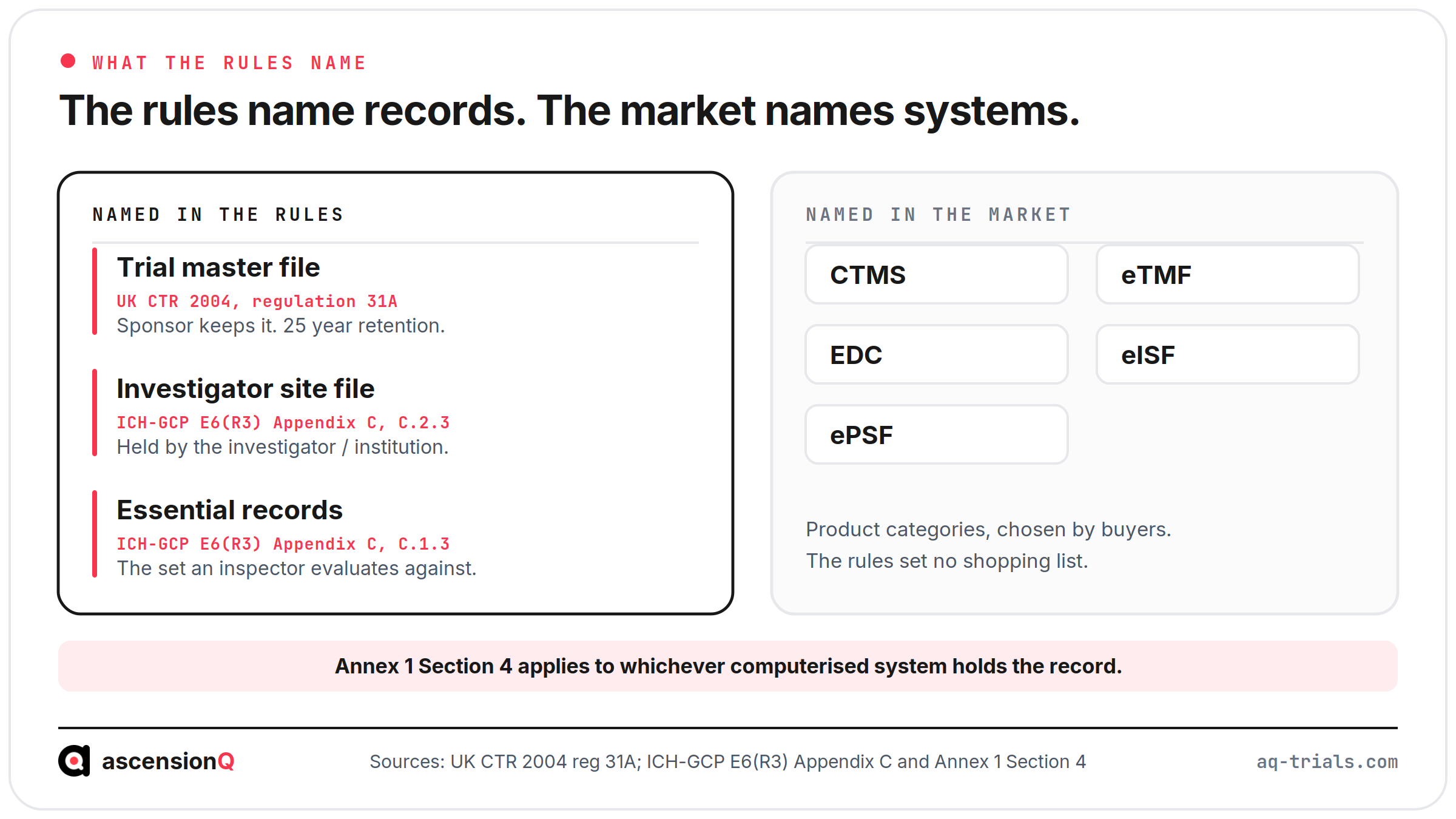
Two of the five appear in the rules. The other three are market categories that describe useful products. This distinction changes how a procurement should be written, because an inspector arrives with a list of records rather than a list of systems.
- The trial master file is named in UK law. Regulation 31A of the Medicines for Human Use (Clinical Trials) Regulations 2004 requires the sponsor to keep a trial master file containing the essential documents that allow the conduct of the trial and the quality of its data to be evaluated, and to keep it readily available for inspection.
- The investigator site file is named in ICH-GCP E6(R3). Appendix C sets out essential records and identifies the trial master file and the investigator site file as the repositories held by the sponsor and the investigator or institution respectively. Section C.2.10 states plainly that some records sit only with the sponsor, some only with the investigator or institution, and some with both.
- Neither instrument names a CTMS or an EDC system. ICH-GCP E6(R3) addresses computerised systems in general terms in Annex 1 Section 4, and sets the same expectations whatever the product category on the invoice.
- The requirements attach to the system that holds the record. Section 4.3.4(a) requires validation proportionate to the risk the system carries, Section 4.2.2(b) requires audit trails to stay enabled, and Section 4.3.8(c) requires authorised users and their permissions to be documented and retained.
- Retention runs for 25 years. Regulation 31A sets a retention period of 25 years beginning with the day after the conclusion of the trial, with a further 2 years after the grant of a UK marketing authorisation supported by the data. Trials submitted before 28 April 2026 fall under the transitional 5 year rule for trial master file documents.
The regulator names records. Vendors name systems. You buy systems and you are inspected on records.
Also Read: The New UK Clinical Trials Regulations (2026): What Sites and Sponsors Must Do
Where Does Each System Stop?
Each category has a boundary, and the boundary decides whether one system is enough. The question worth asking of any product is what it hands to the next system rather than what it contains.
- A CTMS stops at the filed original. It tracks that a monitoring visit happened, who attended and what actions arose, which gives a study manager live oversight. The signed visit report still has to reach the filed record that an inspector reads.
- An eTMF stops at the current operational picture. It holds the approved protocol, the ethics correspondence and the signed agreements in a structured, complete file. It reports on filing status rather than on whether recruitment is behind target this week.
- An EDC system stops at the participant data. It captures values, raises queries and locks the database, which produces a defensible dataset. It carries no view of site capacity, staff delegation or contract status.
- An eISF stops at one site’s copy. It gives coordinators and monitors a current, retrievable site file for the studies that site runs. Cross-portfolio consistency across a trust remains a separate control.
- An ePSF stops at the pharmacy record. It evidences receipt, storage, dispensing and destruction of the investigational product to an auditable standard, and it depends on the visit schedule and delegation held elsewhere to make sense of a dispensing entry.
Two of these boundaries are covered in detail elsewhere on this site. The difference between a CTMS and an EDC system comes down to conduct against data, and the difference between a CTMS and an eTMF comes down to the operational record against the filed record.
Which Records End Up With Two Owners?
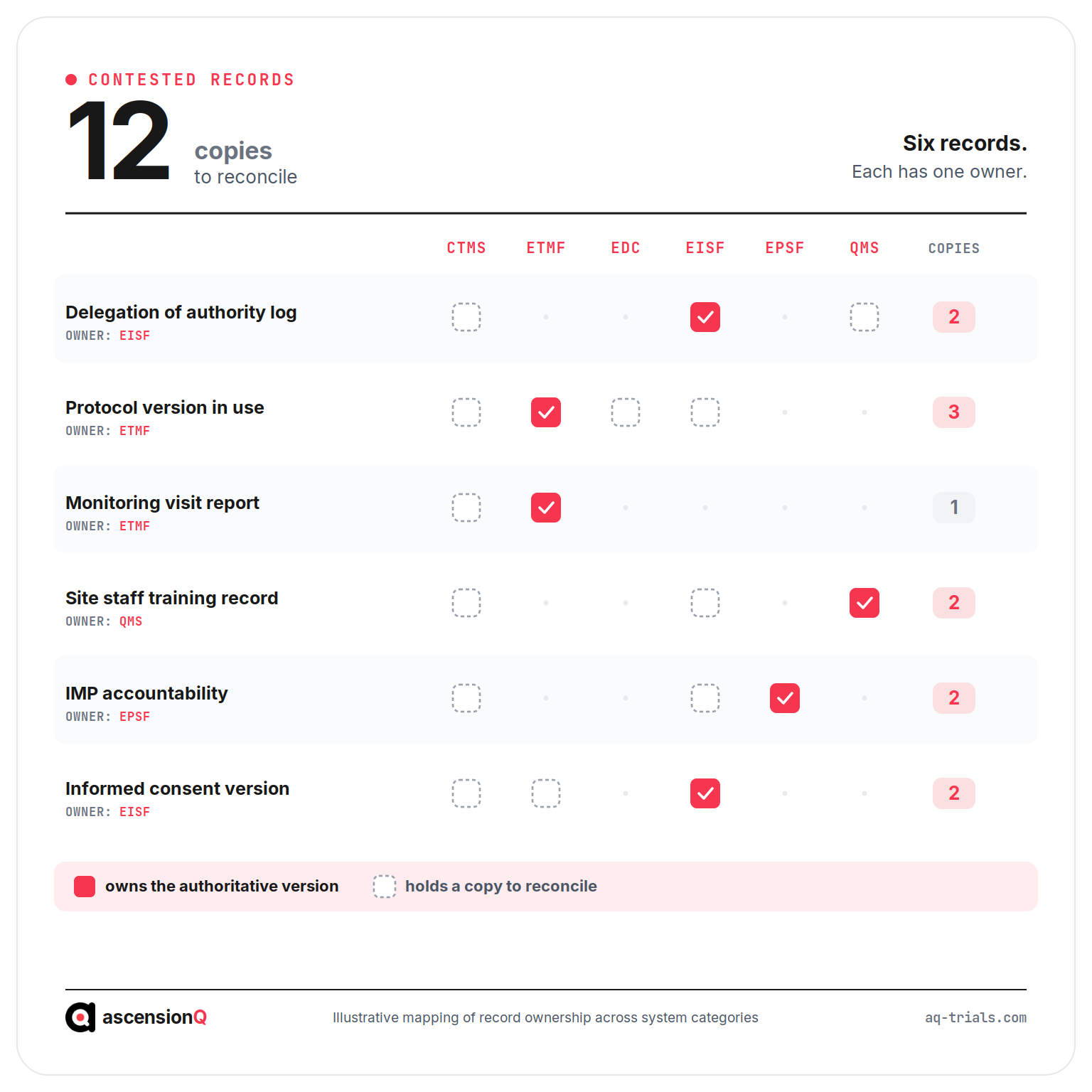
Some records genuinely belong in more than one place, and ICH-GCP E6(R3) Appendix C anticipates this in Section C.2.8, which expects parties to have access to or copies of one another’s essential records during the trial while each retains its own at the end. Trouble arrives when two systems hold a record and no rule says which version governs.
- The delegation of authority log. A CTMS tracks who is authorised to do what, the site file holds the signed log, and the effective date on the entry is what authorises the activity. Two uncontrolled copies produce two answers to the same question, which is why effective dates matter more than signatures.
- Protocol versions and amendments. The eTMF holds the approved version, the site file holds the version in use, and the EDC build reflects the version the data was collected under. Drift between the three shows up later as data nobody can explain.
- Monitoring visit reports. The CTMS records the visit and the follow-up actions. The eTMF holds the signed report. An open action with no filed report is a gap that only shows up when someone compares the two.
- Site staff training records. The quality system holds the training matrix, the site file holds the certificates, and the delegation log assumes both are current before a task is delegated.
- IMP accountability. The pharmacy file holds the dispensing record, the site file holds the accountability log, and the visit record in the CTMS says the participant attended on that date. Three systems describe one event.
- Informed consent versions. The site file holds the signed forms, the eTMF holds the approved template, and the CTMS records the consent visit. A superseded template in use at one site is a finding across all three.
Two owners produce a reconciliation task. The task is invisible while everything agrees and expensive the moment it does not, because the disagreement is discovered by whoever asked the question rather than by the study team.
Also Read: TMF Reference Model and the Investigator Site File: Where eISF Fits
What Does the Wrong Answer Cost at Inspection?
Consider a hypothetical but realistic scenario at a single site. An inspector asks who was delegated to take consent for participant 004 on 14 March, which consent version they used, and whether that person had completed protocol training before the visit. One question crosses four record territories.
- The visit date sits in the operational record held by the study team.
- The delegation entry and its effective date sit in the site file.
- The signed consent form and the version in use sit in the site file, against a template approved in the trial master file.
- The training completion date sits in the quality system.
A team with four disconnected systems answers in four retrievals and then reconciles the dates by hand in front of the inspector. The failure modes are consistent and they repeat across studies.
- Time. Retrieval turns into a search, and search time in front of an inspector reads as weak control of the record.
- Contradiction. Two systems give two dates for the same event, and the inspector now has a second question.
- Orphaned records. A record that no system owns is produced from an inbox, and an emailed copy carries none of the audit trail that Section 4.2.2 expects.
- Retention exposure. A record held only in a system due for decommission has no owner for the 25 year duty that regulation 31A places on the sponsor.
The MHRA guidance on archiving and retention of clinical trial records expects original records or certified true copies, validated scanning processes, and systems that maintain audit trails, metadata and long-term readability. Each of those expectations attaches to a system, so the choice of system is a retention decision as much as an operational one.
Which System Should You Fix First?
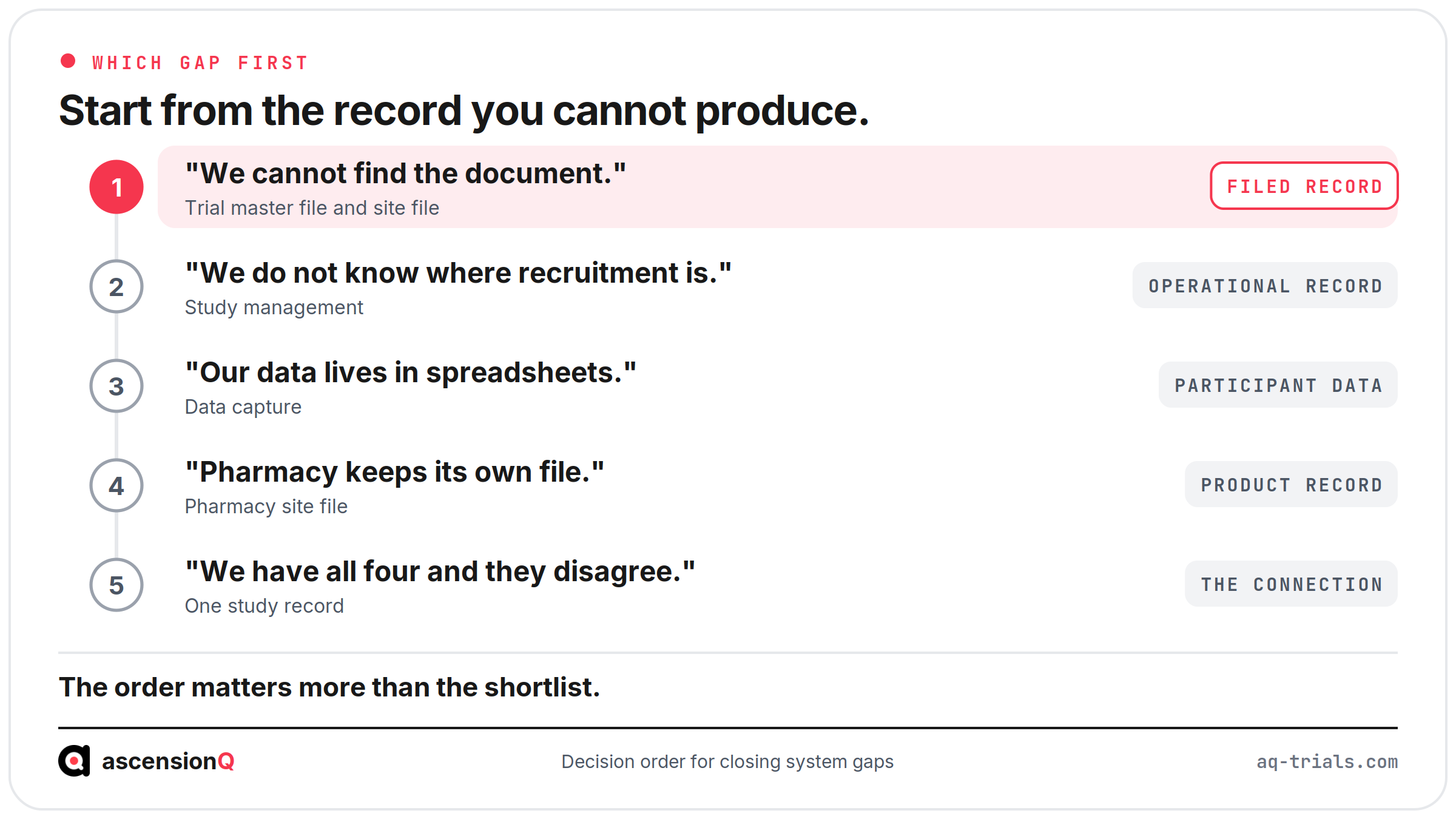
Start from the record you cannot produce, rather than from the category you have heard most about. The sentence a team says out loud points to the system that owns the answer.
- “We cannot find the document.” The filed record is the gap. The trial master file owns the sponsor side, subject to the ALCOA+ attributes, and the site file owns the site side against the essential documents checklist. Fix this first, because retrieval failure is the one an inspector meets on day one.
- “We do not know where recruitment is.” The operational record is the gap. Weekly email counts and a shared capacity spreadsheet are the usual interim, and both fail at portfolio scale once real-time recruitment visibility is the requirement.
- “Our data lives in spreadsheets.” The participant data is the gap, and an EDC system owns it. Validation and audit trail expectations bite hardest here.
- “Pharmacy keeps its own file.” The investigational product record is the gap. Separate files for pharmacy and the site are correct, and the reasons are set out in ePSF versus eISF.
- “We have all four and they disagree.” The connection is the gap. The systems each hold their record correctly and no single study record ties them together.
The order matters more than the shortlist. A team that buys the operational layer while document retrieval still fails has improved the reporting on a record it cannot produce.
Also Read: What Is Clinical Research Software and How to Choose the Right One?
What Should a Demonstration Prove Before You Buy?
A demonstration answers the ownership question directly when the buyer supplies the scenario. Bring one real question from your own portfolio and ask the vendor to answer it in the product.
- Name the record it owns. Ask which records the system holds as the authoritative version and which it holds as a copy, and ask for that answer in writing.
- Trace one event end to end. Ask for a single participant visit shown with its delegation entry, its consent version and its filed document, and count the systems the demonstrator opens.
- Open the audit trail. Ask to see a record changed and the trail that resulted, including the reason for change, in line with Section 4.2.2 of Annex 1.
- Test retrieval under pressure. Ask for a named document from a study that closed two years ago, and time it.
- Ask about the exit. Ask what an export looks like at the end of the 25 year duty, and which party holds the archive obligation in the contract.
- Check the assurance stack. NHS procurement commonly asks for the Data Security and Protection Toolkit, Cyber Essentials and a completed Digital Technology Assessment Criteria return before go-live, and those questions belong in the same conversation.
A structured file also needs a structure that a monitor recognises. The DIA TMF Reference Model gives that common structure, and a system built on it lets a sponsor and a site compare the same zones rather than two local conventions.
How Does AQ Hold These Records in One Study Record?
AQ answers the four questions from one connected study record rather than four separate systems. Each module owns its territory, and the modules share one identity for the study, the site, the participant visit and the person performing the task.
- AQ CTMS centralises study planning, participant management, visit diaries and site capacity in one operational engine, which gives a study team live recruitment and milestone visibility instead of a weekly reconciliation.
- AQ eTMF is built on the DIA TMF Reference Model with structured filing, completeness tracking and review workflows, which lets a sponsor report filing status against a recognised structure at any point in the study.
- AQ eISF keeps essential site documents organised and traceable across concurrent studies with role-based access and 21 CFR Part 11 e-signatures, which makes retrieval and completeness visible daily rather than the week before a visit.
- AQ ePSF replaces paper accountability logs and dispensing diaries with one structured pharmacy file for IMP receipt, storage, dispensing, return and destruction, which keeps the product record auditable alongside the visit that consumed it.
- AQ QMS and CAPA link training currency and quality findings to the study record, which means a delegation entry can be checked against the training that authorised it.
The connection is the point. One study record across the AQ platform means the inspector’s question about participant 004 is answered once, from one place, with one audit trail behind it.
See how the four records hold together on a single study. Book a live demo and bring a question from your own portfolio.